Motorcycle Brake Calipers
Source premium motorcycle brake calipers from vetted manufacturers and suppliers in Asia. Designed for importers, wholesale distributors, and brands seeking reliable OEM and private-label production, our network delivers bulk manufacturing with strict adherence to international safety standards.
Sourcing motorcycle brake calipers in bulk requires a rigorous approach to safety, precision machining, and material integrity. As a critical active safety component, a caliper's performance is entirely dependent on the factory's casting quality, machining tolerances, and assembly environment. Navigating the supplier landscape means identifying manufacturers capable of consistent, defect-free production at scale.
Core Specifications for OEM and Aftermarket Calipers
When developing a custom caliper or sourcing off-the-shelf aftermarket replacements, the technical baseline dictates the factory you select. Not all facilities are equipped for high-performance forging or multi-axis CNC machining.
Manufacturing Methods and Materials
The foundation of any caliper is its body, typically manufactured from aluminum alloy. The chosen production method directly impacts structural rigidity, weight, and unit cost.
| Production Method | Characteristics | Typical Application |
|---|---|---|
| Gravity Casting | Cost-effective, higher risk of porosity, heavier. | Standard commuter and low-cc motorcycles. |
| Low-Pressure Die Casting | Denser structure, better surface finish, moderate cost. | Mid-range street bikes and OEM replacements. |
| Forged & CNC Machined | Highest strength-to-weight ratio, zero porosity, premium finish. | High-performance, track, and premium aftermarket. |
Mounting Styles and Piston Configurations
You must specify the exact mounting geometry and internal configuration.
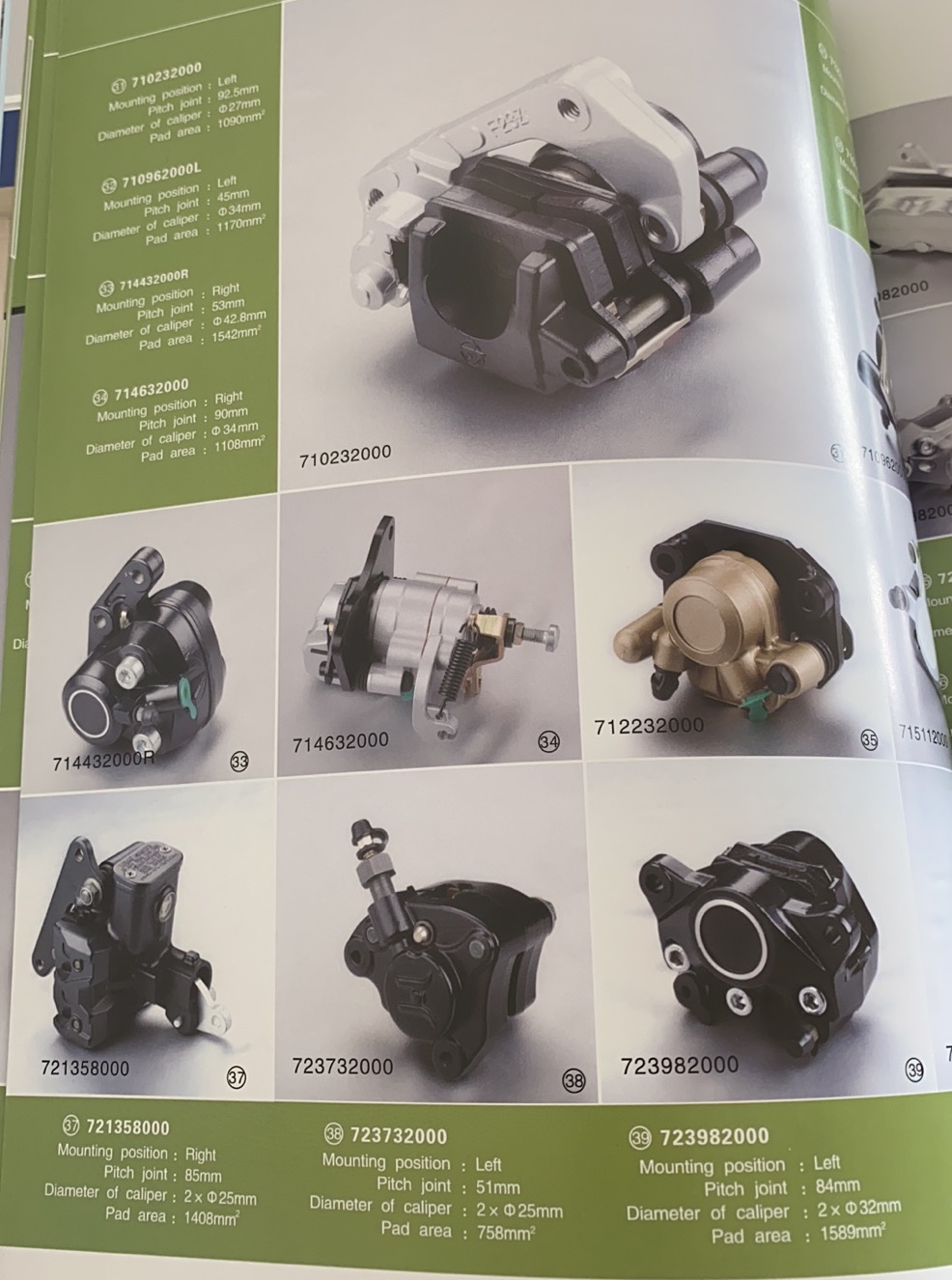
- Axial vs. Radial Mounting: Axial calipers mount perpendicular to the rotor, common on standard bikes. Radial calipers mount parallel to the rotor, offering superior rigidity and pad-to-rotor alignment, standard on modern sportbikes.
- Piston Layout: Options range from single and twin-piston floating designs to 4-piston and 6-piston opposed fixed calipers.
- Piston Material: Standard calipers use steel or aluminum pistons. Premium performance models may specify titanium or specialized coatings (like Kashima or hard anodizing) to reduce thermal transfer to the brake fluid.
Factory Vetting and Quality Control Realities
Brake failure is not an option. Assessing a factory's capability goes far beyond reviewing a product catalog; it requires verifying their quality management systems and on-the-floor testing protocols. Look for facilities holding IATF 16949 certification, which governs automotive and motorcycle part manufacturing.
If you are developing custom components, verifying the factory's engineering capability via rigorous Factory Audits is essential before tooling begins.
Critical Factory Inspection Points for Brake Calipers
- 100% pneumatic or hydraulic pressure testing on the assembly line to verify seal integrity.
- Coordinate Measuring Machine (CMM) reports verifying bore tolerances and mounting hole alignment.
- X-ray or ultrasonic inspection capabilities for cast bodies to detect internal porosity.
- Strict environmental controls in the assembly area to prevent dust contamination of seals.
- Traceability systems linking finished batches back to raw material heat numbers.
The internal seals (dust and fluid seals) are common points of failure in poorly manufactured calipers. Ensure the factory uses the correct elastomer (typically EPDM for DOT 3/4/5.1 brake fluids) and that seal grooves are machined to exact tolerances. Implementing third-party Quality Control & Inspection prior to shipment ensures these hidden defects do not reach your warehouse.
Need to verify a caliper manufacturer's quality systems? We handle factory auditing and technical vetting on the ground in Asia.
Talk to our teamPricing Drivers, MOQs, and Lead Times
Volume pricing for brake calipers is driven by material costs, machining time, surface treatment (standard paint vs. hard anodizing), and the origin of the internal seals.
If you are utilizing OEM/ODM Services to launch a proprietary design, expect to amortize tooling costs over your first few production runs. Modifying an existing factory-owned mold (ODM) with custom branding or surface finishes is a cost-effective way to lower initial MOQs.
Ready to optimize your brake system supply chain? Let us help you negotiate pricing, manage tooling, and oversee production.
Get a free consultationSourcing motorcycle brake calipers demands a rigorous focus on metallurgical integrity, precise machining, and flawless assembly. Partnering with the right factory—one that treats quality control as a baseline rather than an upsell—is the only way to build a reliable, scalable supply chain for safety-critical components.
Get Sourcing Help for Motorcycle Brake Calipers
Tell us your requirements and our experts will connect you with verified manufacturers.