How to Buy from Alibaba Safely for Your First Order
#Introduction
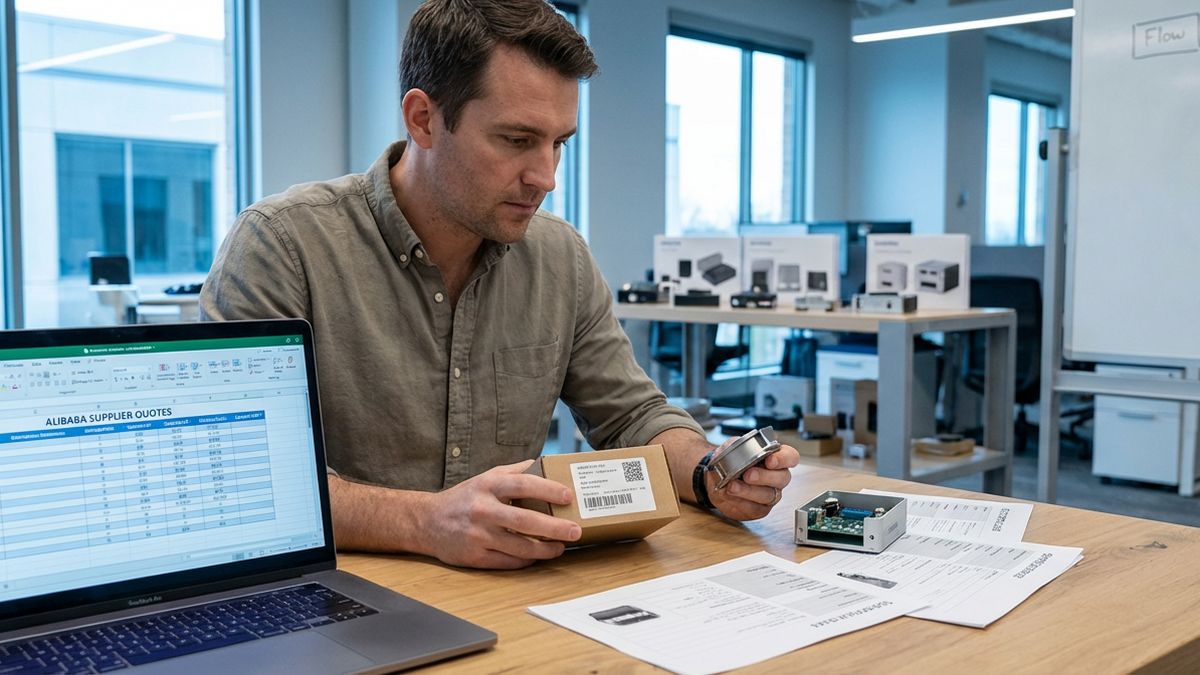
Alibaba looks simple until you actually try to place an order. That is where most first-time buyers get stuck.
The platform is not a shop in the normal retail sense. It is a directory of suppliers, trading companies, factories, agents, and freight offers layered into one interface. That is why beginners often feel confused by MOQs, supplier badges, payment terms, and shipping quotes that seem too good to be true.
This guide shows you how to buy from Alibaba safely for your first order, step by step. It covers how to shortlist suppliers, what to ask before paying, how to handle samples, which shipping terms to avoid, and when it makes sense to get outside help.
We use Alibaba regularly as a sourcing channel, but we treat it as a starting point for verification, not a substitute for due diligence. That distinction is what separates a controlled first order from an expensive lesson.
Need a second pair of eyes before you pay?
We help buyers verify suppliers, review quotes, and set up inspections before money leaves the account.
Speak with our team#What Alibaba Actually Is
The first mindset shift is important: Alibaba is not one supplier. It is a marketplace where different companies advertise to win your enquiry.
Some listings are genuine factories. Some are trading companies. Some are perfectly legitimate but poor fits for your product. Some are good at selling and weak at production. A few are outright risky.
That means your job is not just to find a product photo you like. Your real job is to identify which supplier can repeatedly produce your product at the quality, price, and lead time you need.
The Core Rule
Treat Alibaba as a lead-generation tool. The real buying decision should happen only after you have checked the company, clarified the specification, approved the sample, and understood the shipping terms.
#Is Alibaba Safe for First-Time Buyers?
Yes, but only if you use the platform properly. Alibaba is safer than wiring money to a random website, yet it is not safe enough to replace basic sourcing discipline.
The most common first-order failures are not dramatic scams. They are more ordinary and more expensive:
Buyers usually lose money through unclear specifications, poor supplier selection, weak inspection discipline, or freight surprises. In other words, the platform is rarely the full problem. The buying process is.
#When Alibaba Is a Good Fit
Alibaba works well when you are sourcing a product that is already common in the market and you want to compare a broad set of suppliers quickly.
It is especially useful for:
- Standard or lightly customised products
- Early-stage supplier research
- Sample sourcing
- Low-to-medium volume first orders
- Comparing price bands and MOQ expectations
If you are building a technically demanding product, using proprietary designs, or ordering from multiple factories at once, Alibaba can still help, but the execution risk goes up quickly.
| Best use case | Why it works | Watch-out | |
|---|---|---|---|
| Ready-made products | Fast comparison across many suppliers | You can benchmark price and MOQ quickly | Photos rarely tell you real quality |
| Light customisation | Suppliers already have a base product | Packaging, colour, or logo changes are manageable | Miscommunication is still common without a clear spec sheet |
| Complex custom products | Possible, but only with strict process control | Some suppliers have engineering support | Sample-to-bulk inconsistency becomes a major risk |
| Urgent orders | Possible for stock items only | Lead times may look attractive | Rushed buying decisions cause most expensive mistakes |
#How to Buy from Alibaba Safely: The Practical Process
Most beginners get overwhelmed because they try to solve everything at once. A better approach is to de-risk the order in stages.
Start with a clear brief
Write down the exact product, materials, dimensions, finish, packaging, certification needs, target price, and first-order quantity before contacting anyone.
Shortlist 3-7 suppliers
Compare similar listings, supplier age, response quality, certifications, and whether they can answer technical questions clearly.
Qualify the company
Request business licence, export experience, factory or trading status, production capacity, sample timeline, and recent shipment references.
Order samples before production
Do not approve bulk production from listing photos. Samples reveal quality level, communication quality, and how accurately the supplier follows instructions.
Lock the order in writing
Confirm final specification, acceptable quality standard, packaging details, lead time, payment terms, and shipping term before paying deposit.
Inspect before final payment
A pre-shipment inspection is the last reliable checkpoint. Problems found after arrival are slower, costlier, and harder to dispute.
#Step 1: Build a Real Specification Before You Message Suppliers
The biggest beginner mistake is asking, "How much for this?" with only a screenshot.
Suppliers can only quote accurately when they know what you are actually buying. If your brief is vague, the quotes you receive will be impossible to compare. One supplier may price thin material, another may include better packaging, and a third may ignore compliance requirements entirely.
At minimum, define:
First-Order Spec Checklist
- Exact dimensions, materials, colour, and finish
- Target quantity for first order and likely repeat orders
- Packaging requirements, including labels and barcodes
- Logo or customisation details if applicable
- Required testing, compliance, or market certifications
- Target delivery window and destination country
Once you have this, supplier replies become much more useful. You are no longer comparing personalities. You are comparing actual manufacturing offers.
#Step 2: Shortlist Suppliers Without Trusting the Badges Too Much
Alibaba badges help, but they do not tell the full story.
A verified supplier badge may confirm the company exists. It does not guarantee consistent quality, honest communication, or strong process control. Likewise, a polished storefront may simply mean the supplier is good at digital marketing.
Use badges as a filter, not as a conclusion. Then look for signs of real operational strength:
- Consistent answers to technical questions
- Clear product photos across multiple listings
- Plausible MOQ and lead-time ranges
- Willingness to discuss defects, tolerances, and packaging
- Ability to provide recent export examples
Red Flag
If a supplier pushes you to move payment or messaging off-platform too early, slow down immediately. First orders should stay protected and documented for as long as possible.
#Step 3: Work Out Whether You Are Speaking to a Factory or a Trading Company
This matters because it affects price, speed, transparency, and control. A trading company is not automatically bad, but you should know what you are dealing with.
Factories are usually stronger when you need tighter control, engineering input, or repeat production. Trading companies can be useful when you need lower MOQs, faster communication, or sourcing across several product types.
Factory vs Trading Company
Advantages
- Factory: Better direct control over production and quality decisions
- Factory: Stronger for repeat orders and technical adjustments
- Trading company: Easier communication for beginners
- Trading company: Can combine products from multiple sources
Disadvantages
- Factory: Higher MOQs are common
- Factory: Some are weak at English communication and sales support
- Trading company: Extra margin usually increases cost
- Trading company: Less visibility into where and how goods are actually produced
If the supplier refuses to answer basic questions about their business model, that is useful information by itself.
If you are unsure who you are really dealing with, our factory audit service can verify the company before you place the order.
#Step 4: Samples Are Not Optional
The sample stage is where your first order becomes real. It tells you whether the supplier can follow instructions, whether quality is aligned with your market, and whether your own specification is good enough.
For stock items, one sample may be enough. For customised products, you may need multiple rounds. That is normal. What is not normal is skipping samples because the listing photos look good.
Pay attention to more than the product itself:
- Was the sample delivered on time?
- Did the supplier follow the packaging brief?
- Were defects acknowledged honestly?
- Did communication improve or deteriorate once money was involved?
Those signals often predict how bulk production will go.
Practical Tip
Ask the supplier to send photos and videos of the sample next to a ruler, packaging, and carton labels before they ship it. This catches avoidable mistakes earlier and saves another round trip.
#Step 5: Use Safe Payment Structure, Not Just Safe Payment Method
Buyers often focus on whether Alibaba Trade Assurance is available. That matters, but payment structure matters just as much.
For standard production orders, a common arrangement is 30% deposit and 70% balance after inspection but before shipment. That keeps the supplier funded while preserving some leverage.
What you should avoid on a first order:
- Paying 100% upfront for production
- Paying the full balance before inspection
- Accepting vague invoices with no final specification attached
- Agreeing to major changes only in chat without updated documents
Trade Assurance can help, but it is not magic. If your requirements are vague, disputes become vague too. The safest approach is to make the order documents extremely specific.
#Step 6: Choose Shipping Terms That Do Not Hide the Real Cost
This is where many first-time Alibaba orders go sideways. Buyers compare product price carefully, then accept the first freight option the supplier suggests.
That is risky because cheap-looking freight can become expensive destination charges. Beginners also confuse DDP, DAP, FOB, and CIF, which leads to surprise fees and unclear responsibility.
| What it usually means | Good for first orders? | Main risk | |
|---|---|---|---|
| FOB | Supplier handles export side, you control main freight | Yes, usually the safest balance for sea freight | You need your own forwarder or logistics partner |
| EXW | You handle everything from factory door | Not usually | Too much responsibility for most first-time buyers |
| CIF | Supplier arranges freight to destination port | Sometimes, but with caution | Destination charges can be unpleasantly opaque |
| DDP | Seller arranges delivery including duties | Useful for samples or simple shipments | You can overpay badly if the quote is not benchmarked |
For many first sea-freight orders, FOB is the cleanest option because it separates production from freight. You get clearer pricing and better control. For courier-sized shipments or small test orders, DDP can be convenient if the total landed cost is still competitive.
If freight terms are unclear, our shipping partners can review the quote before you commit.
#Step 7: Inspect Before You Release the Final Payment
Inspection is the point where a professional buying process differs from a hopeful one. Never assume bulk production will match the sample automatically.
Even good suppliers can have process drift. Materials change. Pack-outs go wrong. Logos are applied incorrectly. Cartons get labelled for the wrong market. None of this is rare.
For a meaningful first order, a pre-shipment inspection is one of the highest-return spend items in the process. It is far cheaper than discovering defects after the goods arrive.
Our quality control team can inspect finished goods before the balance is released.
#The Biggest First-Order Mistakes on Alibaba
Most failed orders follow a familiar pattern. The buyer was not foolish. They just moved too quickly at the wrong moment.
Avoid These First-Order Errors
- Choosing the cheapest quote without comparing the specification behind it
- Paying before sample approval is properly documented
- Assuming a verified badge means the supplier is fully trustworthy
- Skipping inspection because the supplier seemed responsive
- Letting the supplier choose freight terms you do not understand
- Ordering too much volume before the product and process are proven
A smart first order is usually smaller than the buyer originally wanted. That is not weakness. It is controlled learning.
#Should You Use the Buy Now Button?
Sometimes, yes. Usually, no.
The Buy Now flow can work for off-the-shelf items, very small sample purchases, or when the listing already reflects the exact configuration you need. For anything customised, negotiated, or commercially important, direct supplier discussion is usually safer.
If the order affects your product quality, margin, or launch date, treat it like a sourcing project rather than an e-commerce checkout.
#When It Makes Sense to Use a Sourcing Partner
You do not need outside help for every Alibaba order. But there are situations where the economics change fast:
- Your product has multiple materials or critical tolerances
- You need to compare factories, not just traders
- You are unsure about freight terms or landed cost
- You cannot afford a failed first shipment
- You want local oversight without building your own team
In those cases, the right support does not replace your decision-making. It reduces the chance that you learn the hard way.
Want help reviewing your shortlist?
We can validate suppliers, pressure-test quotes, and build a safer first-order plan before you place the deposit.
Request a review#FAQ
#Final Takeaway
If you are wondering how to buy from Alibaba safely, the answer is not one trick or one badge. It is a process. Clear specification, disciplined supplier selection, sample approval, written order control, and inspection before final payment are what make the order safe.
Alibaba can be a very useful sourcing tool. It becomes dangerous only when buyers treat it like a normal online shop and skip the steps that real importing requires.
If you want the upside of Alibaba without carrying all the execution risk yourself, we can help you verify the supplier, review the quote, inspect the goods, and organise freight properly.
Make your first Alibaba order boring
The best first order is the one with no surprises. We help buyers verify suppliers, control quality, and manage shipping before problems become expensive.
Talk to a sourcing specialistShare this article
Tagged with:
Related Articles
Alibaba vs Global Sources: Which B2B Platform is Best for Sourcing?
A detailed comparison of Alibaba and Global Sources for finding suppliers. Learn the pros, cons, and best use cases for each platform.
7 First-Time Importer Mistakes to Avoid (And How to Fix Them)
Don't learn the hard way. Avoid these common sourcing mistakes that cost beginners thousands of dollars and months of time.

Sourcing Agent vs. Direct Sourcing: The Definitive Comparison
Should you hire a sourcing agent or go direct to the factory? We analyze the pros, cons, costs, and risks of each model.