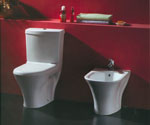
Sanitary Ware Suites
Source premium sanitary ware suites directly from vetted manufacturers and suppliers. Designed for importers, wholesalers, distributors, and brands seeking OEM or private-label production, these coordinated bathroom sets offer consistent glaze quality, durability, and compliance with international water efficiency standards.
Sourcing complete sanitary ware suites—coordinating toilets, basins, pedestals, and bidets into a unified collection—presents unique manufacturing and logistical challenges. Unlike buying individual fixtures, suites require absolute consistency in color, glaze finish, and design language across pieces of vastly different sizes and shapes. A slight temperature variation in the kiln can turn a matching "alpine white" basin and toilet into a mismatched set that is unsellable in premium markets.
Achieving this consistency at scale requires partnering with factories that maintain strict control over their slip casting, glazing, and firing processes.
Core Material and Manufacturing Specifications
The foundation of any high-quality sanitary ware suite is the ceramic body, typically vitreous china. The quality of the raw materials (clay, quartz, feldspar) and the firing process directly determine the product's porosity, strength, and finish.
| Material Type | Water Absorption | Primary Suite Application | Manufacturing Characteristic |
|---|---|---|---|
| Vitreous China | Under 0.5 percent | Toilets, Bidets, Pedestal Basins | High-temperature firing (approx. 1200°C); highly sanitary. |
| Fireclay | Under 1.0 percent | Heavy-duty Basins, Consoles | Thicker, heavier; fired at slightly lower temperatures. |
| Solid Surface / Resin | Near zero | Luxury Vanity Tops, Freestanding Baths | Cast in molds; allows for sharp, modern geometric edges. |
When evaluating a factory's technical capability, pay close attention to their kilns. Continuous tunnel kilns generally offer better temperature stability for large-volume orders compared to shuttle kilns, resulting in fewer color variations across the suite components.
Struggling with color matching across your sanitary ware collections? Let us connect you with manufacturers utilizing advanced continuous tunnel kilns.
Talk to our teamCritical Quality Control Checkpoints
Sanitary ware production is notoriously susceptible to defects. Warping, pinholes, and micro-cracks often only become visible after the final firing. Implementing rigorous Quality Control & Inspection at the factory level is non-negotiable to prevent shipping unsellable goods.
Essential QC Checks for Sanitary Ware Suites
- Color Match Verification: Compare all suite components (basin, toilet, pedestal) under standardized D65 lighting.
- Glaze Thickness and Coverage: Ensure a minimum glaze thickness of 0.8mm to 1.0mm for durability and stain resistance.
- Trapway Glazing: Verify that toilet trapways are fully glazed internally to prevent blockages and odor buildup.
- Dimensional Tolerance: Check that warping does not exceed industry standards (typically maximum 2mm to 3mm depending on piece size).
- Flush Performance Testing: Conduct solid waste and paper clearing tests using standardized media before packing.
The Hidden Defect: Internal Micro-cracks
A visually perfect toilet or basin can harbor internal micro-cracks that cause catastrophic failure during installation or use. Ensure your manufacturer utilizes acoustic resonance testing or specialized dye penetration tests to identify structural flaws that visual inspection misses.
OEM/ODM and Custom Mold Development
For brands looking to differentiate, custom design is critical. Developing proprietary sanitary ware requires significant investment in plaster or resin molds. When engaging in OEM/ODM Services, clarify mold ownership upfront.
Factories typically require a mold fee, which is often refundable after a specific order volume is reached (e.g., 2,000 pieces). Keep in mind that complex, rimless toilet designs or ultra-thin ceramic basins require specialized high-pressure casting techniques, which limits your pool of capable suppliers to top-tier manufacturers in hubs like Chaozhou or Foshan.
Pricing, MOQs, and Logistics Reality
Sanitary ware is high-volume, low-density cargo. Your landed cost is heavily dictated by container optimization and packaging efficiency.
Packaging Strategies
Standard export packaging (5-ply corrugated cartons with basic styrofoam) is often insufficient for LCL (Less than Container Load) shipments or harsh transit routes. For premium suites, specify honeycomb cardboard, custom-molded EPE foam, and palletization. While this adds to the unit cost, it drastically reduces the breakage rate, which can easily exceed 10 percent with inadequate packing.
Need to optimize your container loading and reduce transit breakage? We can audit your supplier's packaging protocols and freight strategy.
Get a free consultationBefore committing to a high-volume order, conducting thorough Factory Audits is highly recommended to verify the supplier's production capacity, quality management systems (ISO 9001), and ethical compliance.
Frequently Asked Questions
Sourcing sanitary ware suites at scale requires balancing aesthetic consistency with rigorous functional testing and optimized logistics. By controlling the specifications down to the glaze thickness and trapway finish, you protect your brand's reputation and your bottom line.
Get Sourcing Help for Sanitary Ware Suites
Tell us your requirements and our experts will connect you with verified manufacturers.