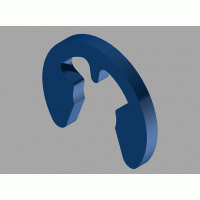
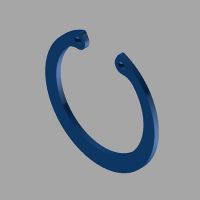
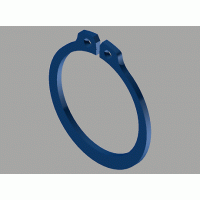
Retaining Rings
Source high-quality retaining rings in bulk from vetted manufacturers and wholesale suppliers. Designed for importers, industrial distributors, and brands requiring reliable OEM production, our network delivers precision-stamped and wire-formed fasteners built to strict international standards for secure assembly.
Retaining rings—commonly referred to as snap rings or circlips—are critical, low-cost components whose failure can lead to catastrophic assembly breakdowns. Sourcing these fasteners in volume requires strict attention to metallurgy, heat treatment, and dimensional precision. The primary procurement challenge isn't merely finding a factory that can stamp metal; it is identifying a manufacturer capable of consistently delivering the exact balance of hardness and elasticity across millions of units so the rings do not permanently deform during installation.
Material Selection and Heat Treatment
The performance of a retaining ring is dictated heavily by its material and the subsequent heat treatment process. Standard rings are typically manufactured from high-carbon spring steel (such as SAE 1060 to 1090). To achieve the necessary spring properties, these rings must undergo austempering. This isothermal heat treatment process yields a bainite structure, providing high strength and toughness while minimizing distortion and the risk of fracture.
For applications requiring corrosion resistance or high-temperature stability, buyers must specify alternative materials. Stainless steel (commonly PH 15-7 Mo or 420) is standard for medical or marine environments, while beryllium copper or phosphor bronze are utilized for non-magnetic or highly conductive requirements.
Need a supplier with verified austempering capabilities? Let us match you with pre-vetted fastener manufacturers.
Talk to our teamManufacturing Methods: Stamping vs. Edge-Winding
Manufacturers generally employ one of two primary production methods, each impacting the final cost, tooling requirements, and structural integrity of the ring.
| Feature | Stamping | Edge-Winding (Wire Forming) |
|---|---|---|
| Tooling Cost | High (requires dedicated dies) | Low to None |
| Material Waste | High (scrap from the center) | Virtually Zero |
| Grain Structure | Interrupted by stamping | Continuous along the ring |
| Best For | Standard DIN/ANSI sizes, ultra-high volume | Custom diameters, heavy-duty applications |
When assessing a new factory, it is critical to verify their tooling maintenance schedules. Worn stamping dies lead to excessive burrs and compromised edge radii, which can prevent the ring from seating properly in its groove. Conducting thorough Factory Audits prior to placing high-volume orders ensures the supplier maintains their equipment to the tolerances required by DIN 471/472 or ANSI standards.
Critical Quality Control Checkpoints
Surface finishes introduce another layer of complexity. If carbon steel rings are zinc-plated for corrosion resistance, they are highly susceptible to hydrogen embrittlement. Plated rings must be baked immediately after the plating process to drive out trapped hydrogen; failure to do so results in rings that snap unexpectedly under load.
Implementing rigorous Quality Control & Inspection protocols at the factory level is non-negotiable. Your QC checklist should include:
Pre-Shipment Inspection Criteria for Retaining Rings
- Hardness testing (Rockwell C scale) to verify heat treatment consistency.
- Dimensional verification of free diameter, thickness, and gap width using optical comparators.
- Permanent set testing (compressing or expanding the ring to its maximum design limit to ensure it returns to its original diameter).
- Salt spray testing for plated or coated batches to verify corrosion resistance.
- Visual inspection for excessive burrs, sharp edges, or tooling marks.
Procurement Mechanics: MOQs, Pricing, and Lead Times
Because retaining rings are produced at high speeds, minimum order quantities (MOQs) are typically high. Pricing is driven primarily by raw material commodity rates, currency fluctuations, and the complexity of the required surface finish.
If you are developing proprietary assemblies that require non-standard ring dimensions, utilizing OEM/ODM Services will involve initial tooling fees, though these are often amortized over the life of the production run.
Struggling with inconsistent fastener quality or high defect rates? We can manage your sourcing and QC end-to-end.
Get a free consultationFrequently Asked Questions
Securing a reliable supply chain for retaining rings means looking past the unit price and interrogating a supplier's metallurgical competence and quality management systems. A thoroughly vetted manufacturing partner ensures your production lines keep moving without the hidden costs of assembly failures.
Get Sourcing Help for Retaining Rings
Tell us your requirements and our experts will connect you with verified manufacturers.