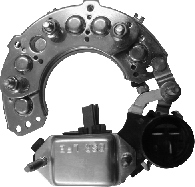
Rectifiers
Source high-quality rectifiers in bulk directly from vetted manufacturers and suppliers. Designed for importers, wholesalers, and electronics brands seeking reliable OEM production, our network delivers consistent discrete semiconductors at scale.
Sourcing discrete semiconductors in high volume requires strict attention to thermal performance, junction integrity, and batch-to-batch consistency. When buying rectifiers at scale, the primary challenge lies in verifying that a supplier's wafer fabrication and packaging capabilities align with your application's reliability requirements, rather than just competing on unit price.
Specifying Rectifiers for Bulk Production
To avoid catastrophic failures in power supplies, inverters, or motor drives, your procurement specifications must go far beyond basic voltage and current ratings. Factories need precise parameters to select the correct die size and packaging.
- Maximum Repetitive Peak Reverse Voltage (VRRM): The maximum voltage the rectifier can withstand in the reverse direction. Ensure your specification includes a safety margin of at least 20 percent over the application's maximum operating voltage.
- Average Rectified Output Current (Io): The maximum continuous current. This is heavily dependent on the thermal resistance of the chosen package (e.g., SMA vs. SMC) and the PCB pad layout.
- Reverse Recovery Time (trr): Critical for switching efficiency. Standard recovery is sufficient for 50/60Hz mains, but switch-mode power supplies (SMPS) require fast or ultrafast recovery times (under 500ns) to minimize switching losses.
- Forward Voltage Drop (Vf): Lower Vf reduces power dissipation and heat. Schottky rectifiers excel here but suffer from higher reverse leakage current at elevated temperatures.
| Parameter | Standard Recovery | Fast Recovery | Schottky |
|---|---|---|---|
| Reverse Recovery (trr) | High (over 1µs) | Low (150-500ns) | Virtually zero |
| Forward Voltage (Vf) | 0.9V - 1.1V | 1.0V - 1.3V | 0.15V - 0.45V |
| Primary Application | 50/60Hz Mains AC/DC | SMPS, Inverters | Low Voltage, High Freq |
Need help verifying a semiconductor manufacturer's technical capabilities? We audit factories to ensure they meet your exact component tolerances.
Talk to our teamManufacturing Tolerances and Quality Control
The reliability of a rectifier is won or lost during the die attach and encapsulation processes. Poorly controlled manufacturing leads to microscopic voids under the silicon die. These voids act as thermal insulators, causing localized hotspots that eventually destroy the component under heavy load.
When evaluating a manufacturer, you must look at their automated optical inspection (AOI) and X-ray capabilities. Reliable suppliers perform routine High Temperature Reverse Bias (HTRB) testing to weed out early infant mortality in the silicon batches. If you are sourcing for demanding environments, coordinating rigorous Quality Control & Inspection before shipment is non-negotiable.
Critical Factory QC Checks for Rectifiers
- Scanning Acoustic Microscopy (SAM) or X-ray to detect die attach voids
- Surge current capability (IFSM) sample destructive testing
- High Temperature Reverse Bias (HTRB) burn-in testing
- Solderability testing on terminal leads to prevent PCB assembly issues
- Thermal resistance verification (Junction-to-Ambient / Junction-to-Case)
Automotive and High-Reliability Applications
If your end product is destined for the automotive sector, standard commercial rectifiers will not suffice. You must mandate AEC-Q101 qualified components, which require a completely different level of traceability and Compliance & Testing at the factory level.
Buying Mechanics: MOQ, Lead Times, and Pricing
Procuring rectifiers directly from Asian manufacturers involves understanding standard packaging formats. Surface-mount devices (SMD) like SMA, SMB, and SMC are sold in tape and reel formats, meaning your Minimum Order Quantity (MOQ) is dictated by the reel size.
Pricing is heavily influenced by silicon wafer costs, copper prices (for lead frames), and the specific epoxy molding compounds used. Custom lead bending for through-hole components or specific binning requirements will increase both cost and lead time.
Navigating the tiered pricing structures of semiconductor fabs can be complex, especially when balancing spot-market availability against scheduled production runs. Utilizing professional Product Sourcing services ensures you secure factory-direct pricing without compromising on component authenticity or reliability.
Struggling with inconsistent lead times or quality fade from your current component supplier? Let's discuss stabilizing your supply chain.
Get a free consultationFrequently Asked Questions
Securing a reliable supply of rectifiers means looking past the datasheet and auditing the production floor. By verifying a manufacturer's thermal management practices and testing rigor, you protect your end products from costly field failures.
Get Sourcing Help for Rectifiers
Tell us your requirements and our experts will connect you with verified manufacturers.