Racing Boats
Source high-performance racing boats from vetted manufacturers and suppliers in China and across Asia. Designed for importers, marine distributors, and brands seeking reliable OEM production in bulk, our network delivers precision-engineered hulls and competition-grade watercraft tailored to your exact specifications.
Sourcing racing boats in commercial volumes requires balancing aggressive hull hydrodynamics with strict weight tolerances and structural integrity. Whether you are importing standardized fiberglass models for a regional racing league or developing specialized carbon-composite hulls under your own brand, the margin for manufacturing error is practically zero.
Core Materials and Hull Construction
The performance of a racing boat hinges on its power-to-weight ratio and hull rigidity. Manufacturers typically offer three tiers of composite construction, each dictating the boat's durability and price point.
| Material Tier | Typical Composition | Primary Application |
|---|---|---|
| Standard Fiberglass | Chopped strand mat with polyester resin | Entry-level leagues, recreational racing |
| Advanced Composite | Woven roving fiberglass with vinylester resin | Club racing, offshore endurance |
| Premium Carbon/Kevlar | Carbon fiber/Kevlar blend with epoxy resin | Professional circuits, high-speed offshore |
Need to verify a factory's composite manufacturing capabilities? We can evaluate their layup processes and material sourcing on the ground.
Talk to our teamWhere Quality is Won and Lost on the Factory Floor
A well-designed hull is only as good as its lamination process. Inconsistent resin distribution or improper curing temperatures will lead to delamination under high-impact wave conditions.
When conducting factory audits, focus on the facility's temperature and humidity controls during the layup phase. Vacuum resin infusion is highly recommended for racing applications, as it ensures an optimal resin-to-fabric ratio, minimizing excess weight while maximizing structural strength.
Critical Inspection Points for Racing Hulls
- Gel coat thickness: Must be uniform to prevent stress cracking without adding unnecessary weight.
- Transom reinforcement: Verify marine-grade plywood or high-density foam coring to handle high-torque outboard engines.
- Stringer system bonding: Ensure structural grid is fully glassed into the hull, not merely spot-tabbed.
- Curing environment: Check that the factory maintains strict climate control to prevent resin blushing.
Catching structural defects after the deck is joined to the hull is incredibly difficult. Implementing rigorous in-line quality control and inspection during the lamination phase is essential to prevent costly failures on the water.
Customization and OEM Production
For brands looking to introduce proprietary hull designs or specific deck layouts, partnering with a factory that offers robust OEM/ODM services is critical. Developing a new mold requires significant upfront investment, typically ranging from 30 to 60 days for tooling alone. Ensure the supplier provides clear IP protection agreements and has the engineering capability to translate your CAD files into precise CNC-milled plugs.
Sourcing Realities: MOQs, Lead Times, and Freight
Racing boats are high-ticket, low-density cargo. This fundamentally alters standard sourcing metrics compared to consumer goods.
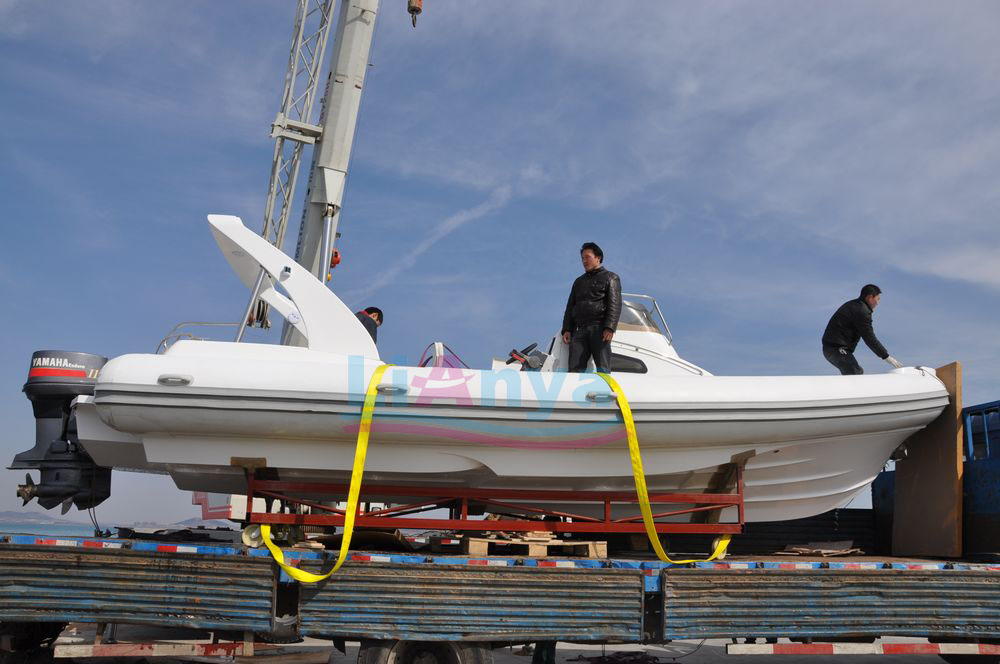
Because boats essentially ship "air," freight costs make up a disproportionate percentage of your landed cost. Efficient nesting (if the design allows) and specialized cradle construction are necessary to maximize container space and prevent transit damage. Coordinating shipping and freight requires forwarders experienced in oversized marine cargo, particularly for offshore models that exceed standard container dimensions and require flat rack shipping.
Struggling to optimize your container loads or negotiate viable MOQs with boat builders? Let us help streamline your supply chain.
Get a free consultationFrequently Asked Questions
Sourcing racing boats in bulk is a high-stakes endeavor where structural integrity and precise logistics dictate your profitability. Success requires moving beyond glossy catalog photos and actively managing the composite manufacturing process on the factory floor. If you need experienced oversight to manage your marine supply chain from mold creation to final delivery, our team is ready to assist.
Get Sourcing Help for Racing Boats
Tell us your requirements and our experts will connect you with verified manufacturers.