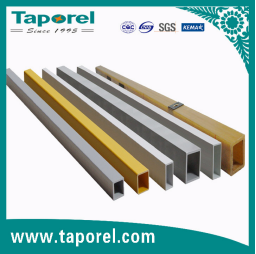
Plastic Profiles
Source bulk plastic profiles from vetted manufacturers and extrusion specialists. Designed for commercial importers, distributors, and brands requiring custom OEM production, this catalog connects you with reliable suppliers capable of meeting strict dimensional tolerances and high-volume demands.
Sourcing extruded plastic profiles at scale requires balancing material science with precise manufacturing controls. Whether you are procuring standard U-channels and T-molding or developing complex, multi-chambered window frames, the core challenge remains consistent: maintaining tight dimensional tolerances across thousands of linear meters while preventing warping, sink marks, or material degradation.
Material Selection and Specification
The foundation of any plastic profile is the polymer blend. Manufacturers in major extrusion hubs (such as Guangdong and Zhejiang) offer a wide variety of resins, but achieving the right balance of rigidity, impact resistance, and UV stability requires precise specification. Standard formulations often need to be modified with impact modifiers, UV stabilizers, or flame retardants depending on the final construction application.
| Material | Common Applications | Key Characteristics |
|---|---|---|
| Rigid PVC (UPVC) | Window frames, siding, pipes | High rigidity, excellent weatherability, cost-effective. |
| Flexible PVC | Weather stripping, edge banding | High elasticity, good chemical resistance, variable Shore hardness. |
| Polycarbonate (PC) | LED diffusers, transparent trims | High impact resistance, excellent light transmission, heat resistant. |
| ABS | Interior trims, structural brackets | High impact strength, easy to machine, good surface finish. |
When specifying materials, always define the required UV rating (e.g., hours of accelerated weathering without color shift) and the exact Shore hardness for flexible components.
The Extrusion Process and Quality Control
Plastic extrusion is a continuous process where small variations in temperature, feed rate, or cooling speed can result in thousands of meters of defective product. The critical phase occurs immediately after the plastic exits the die and enters the vacuum calibration and cooling tanks. If the cooling is uneven, the profile will warp or bow.
To prevent these issues from reaching your supply chain, robust Quality Control & Inspection protocols must be implemented at the factory level.
Critical Inspection Points for Extruded Profiles
- Dimensional Tolerance: Verify wall thickness and overall profile dimensions using calipers and optical comparators.
- Straightness and Bowing: Check for linear deviation over a standard length (e.g., maximum 2mm deviation per meter).
- Surface Finish: Inspect for die lines, sink marks, pitting, or inconsistent gloss levels.
- Color Consistency: Measure color match against master samples using a spectrophotometer (Delta E under 1.0).
- Mechanical Performance: Conduct impact testing and tensile strength tests on sample cut-offs.
Ensure your extrusion tooling and mass production meet strict dimensional tolerances with on-the-ground engineering support.
Talk to our teamCustom Tooling and Co-Extrusion
Many construction and architectural applications require proprietary shapes. Developing custom dies is a standard practice, but it requires a manufacturer with strong in-house tooling capabilities. When engaging in OEM/ODM Services, the design of the die must account for "die swell"—the tendency of the polymer to expand as it exits the tooling.
Additionally, many modern profiles utilize co-extrusion, where two different materials are extruded simultaneously through a single die. A common example is a rigid UPVC channel with a flexible thermoplastic elastomer (TPE) lip acting as an integrated weather seal. Co-extrusion requires specialized dual-screw extrusion lines, which not all suppliers possess. Conducting thorough Factory Audits is essential to verify that a supplier actually has the machinery required for complex, multi-material profiles rather than subcontracting the work.
Pricing, MOQs, and Production Lead Times
Pricing for plastic profiles is heavily dependent on the raw material market (linked to petroleum prices), the complexity of the tooling, and the required production volume. Because setting up an extrusion line and calibrating the die results in significant material waste at the start of the run, manufacturers enforce Minimum Order Quantities (MOQs) to ensure profitability.
Tooling Ownership
Always negotiate tooling ownership upfront. A standard agreement stipulates that the buyer owns the extrusion die once the tooling fee is paid, or the manufacturer rebates the tooling cost after a specific order volume threshold is met.
Navigate custom tooling negotiations and secure favorable pricing structures for high-volume extrusion orders.
Get a free consultationFrequently Asked Questions
Successful procurement of plastic profiles comes down to controlling the variables: precise material specification, rigorous tooling design, and strict quality oversight during the critical cooling phases. By proactively managing these technical elements, buyers can secure reliable, high-volume supply chains that consistently meet architectural and construction standards.
Get Sourcing Help for Plastic Profiles
Tell us your requirements and our experts will connect you with verified manufacturers.