Oilfield Stabilizers
Source premium oilfield stabilizers in bulk from vetted manufacturers and suppliers. Designed for procurement managers, distributors, and OEM brands, our network delivers API-compliant drilling stabilizers built to withstand severe downhole conditions, ensuring precise trajectory control and maximum durability.
Oilfield stabilizers dictate drilling string performance, preventing unintentional sidetracking, minimizing vibration, and maintaining borehole quality. When sourcing these critical components in volume, the challenge is rarely finding a factory that can machine a spiral blade. The true sourcing challenge lies in securing a supplier with certified forging capabilities, precise heat treatment controls, and flawless hardfacing application that strictly meets API Spec 7-1 standards.
Crucial Specifications and Metallurgy
Downhole tools operate in extreme environments where material failure results in catastrophic downtime. When submitting RFQs to overseas manufacturers, generic specifications will yield inconsistent results. You must dictate the metallurgy and mechanical properties explicitly.
The industry standard for integral blade stabilizers (IBS) is AISI 4145H modified alloy steel. Buyers must specify the required mechanical properties after heat treatment, typically requiring a minimum yield strength of 110,000 psi and a Brinell hardness range of 285 to 341 HBW.
Essential RFQ Specifications for Stabilizers
- Material grade (e.g., AISI 4145H Mod, non-magnetic Monel, or P750 for specialized applications)
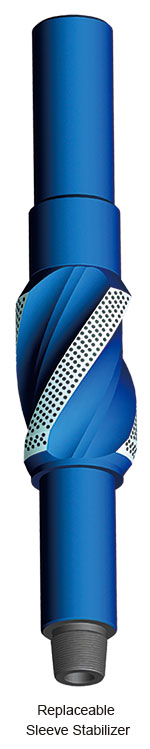
- Blade type (Integral, Sleeve, or Welded) and configuration (Straight or Spiral)
- Hardfacing standard (HF1000 to HF5000)
- Connection types (API NC, REG, or FH) and thread treatments (cold-rolled roots, phosphated)
- Required non-destructive testing (NDT) reports (UT and MPI)
Manufacturing Processes and Quality Control
The durability of a stabilizer is determined entirely on the factory floor during forging, heat treatment, and hardfacing. Many lower-tier suppliers purchase pre-forged billets from third parties, losing control over the initial grain structure.
Verifying a supplier's internal capabilities is critical. Conducting rigorous Factory Audits ensures the facility has the specialized heat-treatment furnaces required to achieve uniform hardness across the entire length of the tool, not just the surface.
API 7-1 Compliance
Do not accept verbal assurances of API compliance. Require full traceability, including Material Test Reports (MTRs) and third-party verification of API Spec 7-1 thread gauging before mass production begins.
Once machined, the hardfacing application is the most common point of failure. Poorly applied hardfacing leads to premature spalling downhole. Implementing strict Quality Control & Inspection protocols before shipment is non-negotiable. Inspectors should mandate ultrasonic testing (UT) for internal flaws and magnetic particle inspection (MPI) for surface cracks on all connections and blade welds.
Need to verify a stabilizer manufacturer's API certifications and heat-treatment capabilities before placing a bulk order?
Talk to our teamHardfacing Standards Explained
The type of formation your end-users are drilling determines the necessary hardfacing. Sourcing the wrong hardfacing type will either unnecessarily inflate your costs or lead to rapid tool degradation.
| Hardfacing Type | Composition | Best For |
|---|---|---|
| HF1000 | Crushed tungsten carbide in a nickel bronze matrix | Soft formations |
| HF2000 | Trapezoidal tungsten carbide inserts | Medium to hard formations |
| HF3000 | Tungsten carbide inserts set in a powder spray deposit | Abrasive, hard formations |
| HF4000 | Tungsten carbide inserts (button type) | Highly abrasive formations |
Pricing Dynamics, MOQs, and Lead Times
Sourcing oilfield equipment requires planning around raw material availability and complex machining schedules. Partnering with an expert in Product Sourcing can help navigate these variables and secure favorable terms.
Pricing is heavily dependent on the chosen hardfacing material and the outside diameter (OD) of the stabilizer. Non-magnetic stabilizers, required for MWD/LWD applications, command a significant premium over standard AISI 4145H tools due to the high cost of specialized alloys.
Managing custom hardfacing specs and strict API compliance across overseas suppliers? Let us streamline your procurement.
Get a free consultationFrequently Asked Questions
The cost of a downhole failure dwarfs the purchase price of a stabilizer. Successful bulk sourcing in this category requires looking past the unit price to rigorously validate the metallurgical integrity and machining precision of the factory producing your tools.
Get Sourcing Help for Oilfield Stabilizers
Tell us your requirements and our experts will connect you with verified manufacturers.