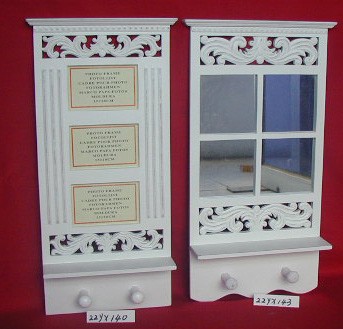
Mirror Sets
Source premium mirror sets directly from vetted manufacturers and wholesale suppliers. Designed for importers, home decor distributors, and brands seeking reliable OEM/private-label production. Secure competitive bulk pricing with rigorous quality control.
Sourcing mirror sets at scale introduces a unique set of challenges compared to single decorative pieces. Because these items are displayed as a cohesive group—often hung closely together on a single wall—buyers must ensure absolute uniformity in frame finishes, glass tint, and edge beveling across multiple production runs. Furthermore, the fragile nature of multi-piece sets demands rigorous packaging engineering and precise supply chain coordination to survive international freight without catastrophic damage rates.
Core Specifications: Glass and Frame Materials
The perceived value and longevity of a mirror set depend entirely on the material specifications you negotiate with the factory. Relying on default factory specifications often leads to premature oxidation or inconsistent frame weights.
Glass Quality and Backing
Not all mirrors are created equal. The backing dictates the reflectivity, lifespan, and resistance to humidity.
- Aluminum Mirrors: Lower cost, but prone to distortion and faster degradation. Suitable only for extreme budget lines.
- Silver Mirrors: The industry standard for home decor. Provides a brighter, more accurate reflection.
- Copper-Free Silver Mirrors: The premium tier. By eliminating copper from the backing process, these mirrors offer superior resistance to corrosion (the "black edge" effect) and are more environmentally friendly during production.
Most decorative mirror sets utilize 3mm or 4mm thick glass. Thinner glass (under 3mm) is highly susceptible to warping, causing a funhouse-mirror effect, while 5mm glass is generally unnecessarily heavy for multi-piece wall sets.
Frame Material Comparison
Frames dictate the tooling costs, unit weight, and aesthetic finish. If you are developing custom designs via OEM/ODM Services, selecting the right substrate is your first major decision.
| Material | Tooling Cost | Unit Cost | Characteristics |
|---|---|---|---|
| Polystyrene (PS) | Low | Low | Lightweight, water-resistant, ideal for ornate molded designs. |
| MDF / Wood | Low | Medium | Classic feel, heavier, requires strict moisture control during transit. |
| Aluminum Alloy | High | High | Modern thin-edge profiles, highly durable, premium finish. |
| Iron / Steel | Medium | High | Heavy, requires excellent powder coating to prevent rust. |
Developing a custom mirror set line? Let us help you match your design requirements with the right specialized manufacturer.
Talk to our teamQuality Control and Common Manufacturing Defects
Because mirror sets are manufactured in batches, a single calibration error on the production line can ruin an entire container. Verification must happen on the factory floor before packaging.
Critical In-Line Inspection Points
- Glass Flatness: Check for surface distortion using a grid reflection test.
- Edge Finishing: Ensure all exposed edges (especially frameless sets) are polished or beveled uniformly without micro-chips.
- Backing Adhesion: Verify the silvering layers are fully sealed to prevent edge oxidation.
- Finish Consistency: Compare frame colors across multiple pieces in the set to ensure exact batch matching.
- Hardware Load Testing: Ensure D-rings or keyhole brackets are rated for at least double the weight of the individual mirror.
Catching these issues requires structured Quality Control & Inspection protocols. Once a mirror is sealed in mail-order packaging, identifying a mismatched frame finish or a chipped edge becomes incredibly labor-intensive.
Packaging Engineering: Surviving International Transit
The highest hidden cost in sourcing mirror sets is transit damage. A low unit price is irrelevant if 15 percent of your container arrives shattered.
Avoid EPS Foam for Mail-Order
Many budget factories default to EPS (Expanded Polystyrene) foam to cut costs. EPS is brittle and crumbles upon impact, offering poor shock absorption for heavy glass. Always specify EPE (Expanded Polyethylene) foam or custom-molded pulp for high-impact protection, especially if the sets will be shipped directly to end consumers.
For e-commerce or catalog distributors, mandate that the factory's packaging passes ISTA 1A or 3A drop testing. This usually involves a 5-ply corrugated master carton, EPE foam encasing the entire set, and reinforced corner protectors.
Buying Mechanics: MOQs, Pricing, and Lead Times
Sourcing mirror sets requires navigating varying MOQs based on your frame material and customization needs. Validating a factory's true production capacity through comprehensive Factory Audits ensures they can meet your volume and lead time requirements.
Pricing is highly sensitive to raw material costs (especially glass and aluminum) and packaging requirements. Upgrading from standard retail packaging to certified mail-order packaging can add 15 to 30 percent to the FOB unit cost, but this investment drastically reduces chargebacks and return logistics.
Need to secure reliable production and drop-test certified packaging? Our sourcing experts can manage the entire procurement cycle.
Get a free consultationFrequently Asked Questions
Successfully sourcing mirror sets requires balancing aesthetic precision with rigorous structural and packaging standards. By specifying the exact glass backing, frame substrate, and shock-absorbing packing materials upfront, buyers can build a highly profitable, low-return product line.
Get Sourcing Help for Mirror Sets
Tell us your requirements and our experts will connect you with verified manufacturers.