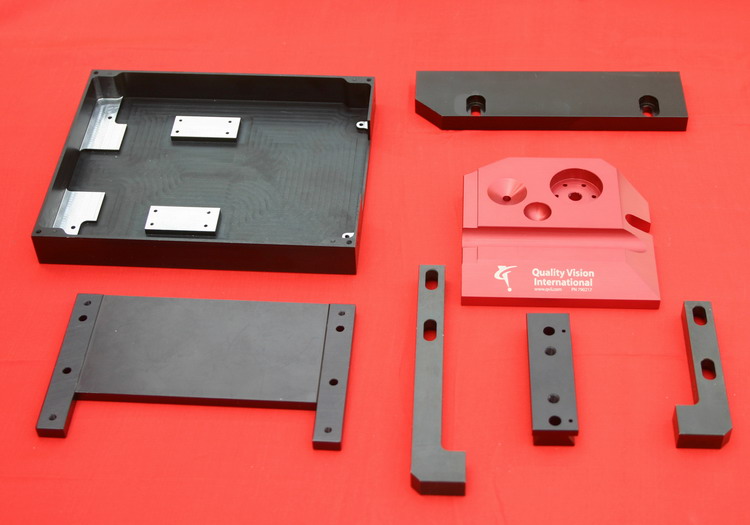
Machining Services
Source precision machining services from vetted suppliers and manufacturers across Asia. Designed for procurement managers, industrial distributors, and brands requiring OEM/ODM production, our network delivers scalable CNC milling, turning, and grinding with rigorous quality control for high-volume manufacturing.
Sourcing machining services in volume from overseas facilities requires moving beyond a simple 3D model handoff. Success in offshore precision manufacturing depends on aligning your geometric dimensioning and tolerancing (GD&T) requirements with a factory's specific machine park capabilities, tooling maintenance routines, and raw material supply chain. When scaling up from prototyping to bulk production, the focus shifts entirely to process repeatability and cost optimization.
Specifying Machined Components for Bulk Production
To ensure accurate pricing and prevent catastrophic yield issues, technical drawing packages must leave zero room for interpretation. Chinese and Asian machine shops typically default to standard tolerances (often ISO 2768-m) unless otherwise specified.
When requesting quotes, your documentation must clearly define:
- Critical Tolerances: Highlight only the dimensions that require tight tolerances (e.g., ±0.01mm or tighter). Over-tolerancing non-critical features forces the factory to use slower feed rates or secondary operations, driving up cycle times and costs unnecessarily.
- Surface Finish (Ra): Specify required roughness averages for functional surfaces. Note whether the finish should be achieved as-machined or through secondary processes like bead blasting, electropolishing, or anodizing.
- Material Certification: Specify the exact alloy grade (e.g., Aluminum 6061-T6, Stainless Steel 316L, Titanium Grade 5). Because local Asian material designations (like GB standards) can differ slightly from ASTM standards, specify acceptable chemical composition ranges if cross-referencing local equivalents.
| Machine Configuration | Optimal Application | Cost & Volume Impact |
|---|---|---|
| 3-Axis CNC | Planar features, simple brackets, enclosures | Lowest setup cost; ideal for high-volume, single-setup parts. |
| 4-Axis CNC | Cylindrical parts, features on sides of a cylinder | Reduces manual repositioning; lowers labor costs at scale. |
| 5-Axis CNC | Complex aerospace/medical geometries, deep pockets | High hourly rate; justified only by eliminating multiple setups. |
Factory Floor Realities and Quality Control
The gap between a factory that can machine a golden sample and one that can deliver 10,000 flawless units lies in their process control. Tool wear, coolant temperature fluctuations, and machine thermal expansion all introduce dimensional drift over a long production run.
Before committing to a high-volume order, it is critical to verify the supplier's infrastructure. Thorough Factory Audits should assess the age and brand of their CNC centers (e.g., Haas, Mazak, Fanuc), their tool-changing protocols, and their in-house metrology lab.
Critical Production Controls to Verify
- Routine calibration of Coordinate Measuring Machines (CMM)
- Incoming raw material verification using OES (Optical Emission Spectrometry)
- Documented tool-life management systems to prevent dull-tool chatter
- In-line inspections at specified intervals (e.g., every 50th part)
- Proper deburring and ultrasonic cleaning stations post-machining
Implementing professional Quality Control & Inspection before shipment ensures that dimensional drift or surface defects are caught before the parts are containerized.
Need to verify a machine shop's actual capabilities and quality systems before committing to a production run?
Talk to our teamCost Drivers, MOQs, and Lead Times
Machining costs are fundamentally driven by machine time, setup complexity, and material yield. Unlike casting or injection molding, there are no expensive molds to amortize, but the variable cost per unit remains highly sensitive to cycle time.
- Setup vs. Run Time: A part requiring six manual re-orientations on a 3-axis machine will incur high labor costs and increased risk of tolerance stacking. Redesigning for fewer setups or utilizing 5-axis equipment can optimize bulk runs.
- Material Yield: Machining from solid billet often results in 50 percent to 80 percent material waste. For very high volumes, consider near-net-shape forging or casting prior to final CNC machining to reduce material costs.
- Economies of Scale: While CNC machining is flexible, volume still dictates price. Purchasing raw materials in multi-ton batches lowers the per-kilo cost significantly.
For brands developing proprietary hardware, utilizing comprehensive OEM/ODM Services can streamline the transition from prototype iteration to locked-in mass production, ensuring that DFM (Design for Manufacturing) feedback is integrated early.
Looking to optimize your landed costs and secure reliable capacity for high-volume machined components?
Get a free consultationFrequently Asked Questions
Matching your specific part complexity, material requirements, and volume to the right tier of machine shop is the single most critical factor in offshore sourcing. Over-specifying to a low-tier shop results in high defect rates, while sending simple parts to an aerospace-grade facility guarantees you will overpay. Aligning your procurement strategy with validated factory capabilities ensures stable pricing and consistent quality.
Get Sourcing Help for Machining Services
Tell us your requirements and our experts will connect you with verified manufacturers.