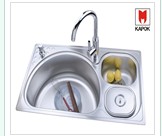
Kitchen Sinks
Source premium kitchen sinks from vetted suppliers and manufacturers across Asia. Designed for importers, distributors, and brands requiring reliable bulk supply or OEM/ODM production. Secure competitive wholesale pricing on commercial and residential fixtures built to exact specifications.
Successfully sourcing kitchen sinks at volume requires balancing raw material integrity, manufacturing precision, and aesthetic durability. Whether you are procuring standard drop-in units for large-scale residential developments or developing custom workstation sinks for a premium retail brand, the difference between a high-margin product and a costly return often comes down to factory-level quality control and exact specification management.
Manufacturing Methods and Material Specifications
The foundation of any stainless steel kitchen sink is the grade and thickness of the steel. While 304 stainless steel is the global standard for premium sinks due to its chromium-nickel composition (typically 18/8) offering superior corrosion resistance, cost-sensitive markets often utilize 201 stainless steel. Verifying that a factory is not substituting 201 for 304 is a primary concern during production.
Beyond the material grade, the manufacturing method dictates both the aesthetic possibilities and the tooling investments required.
| Specification | Pressed (Drawn) Sinks | Handmade (Welded) Sinks |
|---|---|---|
| Manufacturing Process | Stamped from a single steel sheet using a hydraulic press | Cut, folded, and hand-welded at the seams |
| Tooling Investment | High (requires expensive custom molds for new designs) | Low (relies on laser cutting and folding machinery) |
| Corner Radius | Larger, sweeping corners (easier to clean) | Tight radius (R10, R0) for a modern, industrial look |
| Typical Gauge | 18G to 22G (thinner steel required for stretching) | 16G to 18G (thicker steel easily accommodated) |
When developing custom designs, leveraging professional OEM/ODM Services ensures that your CAD files translate accurately to the factory floor, particularly when calculating the exact bend allowances for handmade sinks or engineering the draft angles for drawn sinks.
Need help identifying the right manufacturing partner for your specific sink specifications and tooling requirements?
Talk to our teamFinishes, Sound Dampening, and Quality Control
Modern kitchen sinks are expected to perform quietly and maintain their finish under heavy daily use. Standard brushed or satin finishes are achieved through mechanical polishing, but premium sinks increasingly feature PVD (Physical Vapor Deposition) or nano-coatings for unique colors like matte black, gunmetal, or gold. These advanced finishes require strict environmental controls at the factory to prevent delamination or uneven coating.
Sound dampening is another critical performance metric. High-quality sinks utilize dense EVA rubber pads adhered to the bottom and sides, followed by a heavy-duty spray undercoating. This combination prevents condensation and deadens the acoustic resonance of falling water and clattering dishes.
Implementing rigorous Quality Control & Inspection protocols is essential to catch manufacturing deviations before containers are loaded.
Critical Pre-Shipment Inspection Points
- Material verification: Spectrometer testing to confirm true 304 stainless steel composition.
- Drainage slope testing: Ensuring the X-flume or base slope prevents water pooling.
- Weld seam integrity: Checking for pinholes, burn-through, and polishing consistency on handmade units.
- Finish adhesion: Cross-hatch testing for PVD and nano-coatings to ensure durability.
- Acoustic treatment: Verifying sound-dampening pad coverage and undercoating thickness.
- Dimensional tolerance: Ensuring exact cutout dimensions for undermount and flush-mount installations.
Sourcing Dynamics: MOQs, Pricing, and Lead Times
Pricing in the kitchen sink category is highly sensitive to raw material indices (specifically global nickel and steel prices), the gauge of the steel, and the complexity of the finish.
Because pressed sinks require significant machinery, the factories producing them tend to be larger, capital-intensive operations. Conversely, handmade sinks can be produced by smaller workshops with lower overhead. Conducting thorough Factory Audits is crucial to verify that a supplier actually possesses the in-house pressing machinery or laser-welding capabilities they claim, rather than simply subcontracting your order to a third party.
Want to benchmark your current pricing or negotiate better terms with verified sink manufacturers?
Get a free consultationFrequently Asked Questions
Navigating the kitchen sink supply chain requires a firm grasp of metallurgy, manufacturing tolerances, and factory capabilities. By setting precise specifications and enforcing strict quality control parameters at the source, you can secure reliable, high-quality inventory that meets the demands of your market.
Get Sourcing Help for Kitchen Sinks
Tell us your requirements and our experts will connect you with verified manufacturers.