Ice Cream Tools
Source premium Ice Cream Tools in bulk directly from vetted manufacturers and wholesale suppliers. Designed for importers, distributors, and brands seeking reliable OEM and private-label production, our catalog covers commercial-grade dippers, mechanical scoops, and accessories, ensuring strict food-safety compliance and durability.
Sourcing ice cream tools in volume requires balancing mechanical durability with strict food-contact safety standards. Whether you are procuring commercial-grade conductive dippers for hospitality distributors or ergonomic trigger scoops for a consumer retail brand, the core challenges remain the same: preventing plating failures, ensuring mechanism longevity, and verifying the safety of internal defrosting fluids.
To build a reliable supply chain for these high-stress kitchen gadgets, buyers must look past external aesthetics and closely evaluate the underlying metallurgy, finishing processes, and factory-level quality control systems.
Material Specifications and Manufacturing Processes
The choice of base material and finishing dictates not only the product's lifespan but also its target market and price point. Most production in major manufacturing hubs like Yangjiang (Guangdong province) centers around three primary material profiles.
| Base Material | Target Application | Manufacturing Process | Critical Vulnerability |
|---|---|---|---|
| Zinc Alloy | Premium Retail | Die-casting + Chrome/Nickel Plating | Plating delamination from thermal shock |
| Aluminum (Conductive) | Commercial / Gelaterias | Die-casting + Teflon/Anodizing | Internal fluid leakage at the end-cap seal |
| 304 Stainless Steel | Heavy-Duty Consumer | Stamping, Welding & Polishing | Spring fatigue in trigger mechanisms |
Conductive Aluminum Dippers
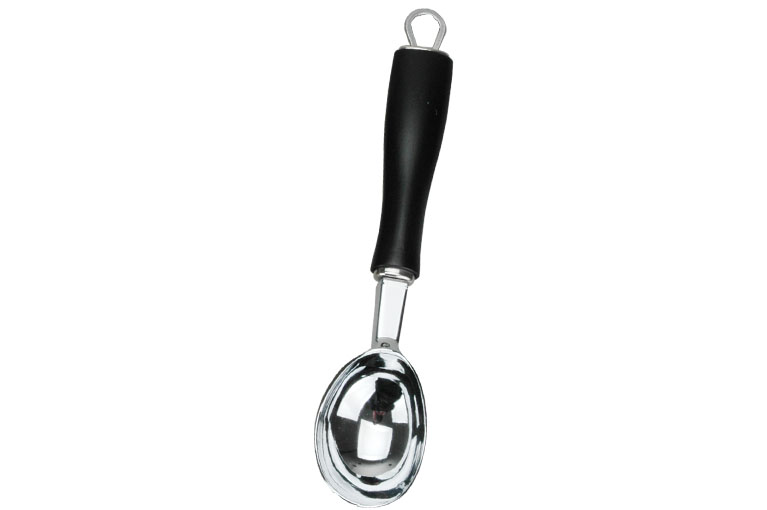
For commercial applications, aluminum is favored for its high thermal conductivity. These tools often feature a hollow handle filled with a non-toxic defrosting fluid (typically a food-safe glycol mixture) that transfers heat from the user's hand to the scoop bowl. The critical manufacturing step here is the ultrasonic welding or threading of the handle cap. A microscopic failure in this seal will result in fluid leakage after repeated commercial washing cycles.
Zinc Alloy and Plating Integrity
Zinc alloy provides the heavy, premium feel demanded by high-end consumer brands. However, because raw zinc reacts poorly with acidic foods and moisture, it must be heavily plated—usually with copper, then nickel, and finally chrome. If the factory cuts corners in the pre-plating acid wash or uses contaminated electroplating baths, the chrome will inevitably blister and flake off into the food.
Struggling to eliminate plating defects in your current supply chain? Our engineering team can help you audit factories for proper electroplating controls.
Discuss your material requirementsQuality Control and Compliance
Ice cream tools operate under severe mechanical stress (prying frozen solids) and rapid temperature changes. Verifying quality before shipping is non-negotiable.
When establishing your Quality Control & Inspection protocols, ensure your inspectors are pulling samples for destructive testing, not just visual checks.
Essential QC Checks for Ice Cream Tools
- Cross-hatch adhesion testing (ASTM D3359) on all plated zinc models to verify finish integrity.
- Cycle testing for trigger scoops: minimum 5,000 actuations to check spring retention and gear alignment.
- Submersion testing in hot water (over 85°C) for conductive aluminum dippers to check for expanding fluid leaks.
- Spectrometer analysis on stainless steel components to verify 304 grade (preventing substitution with 201 grade).
Furthermore, all materials touching the food must pass relevant market regulations. For the US market, this means FDA GRAS (Generally Recognized As Safe) standards; for the EU, the much stricter LFGB testing is required. Because testing every batch is expensive, it is vital to source from manufacturers who maintain consistent material supply chains. We highly recommend utilizing professional Compliance & Testing services to independently verify that the factory's silicone grips, Teflon coatings, and metal finishes meet your destination market's legal requirements.
Pricing, MOQs, and Customization Realities
Navigating the pricing landscape requires understanding the factory's tooling and assembly costs.
If you are developing a unique ergonomic handle or a proprietary bowl shape, you will need comprehensive OEM/ODM Services. A new die-casting mold for a zinc alloy scoop typically costs between $1,500 and $3,000, depending on complexity and the number of cavities.
Pricing is highly sensitive to the weight of the raw material and the polishing standard. A "mirror polish" on stainless steel requires significantly more manual labor than a brushed finish. When comparing quotes, ensure suppliers state the exact weight of the product in grams, the specific grade of metal, and the plating thickness. A quote that is 20 percent cheaper often means the supplier has hollowed out the handle or thinned the bowl wall, drastically reducing the tool's ability to pry hard ice cream without bending.
Need accurate pricing for your custom ice cream tool designs? Connect with our sourcing experts to find the right manufacturing partner.
Get a sourcing quoteFrequently Asked Questions
Sourcing durable ice cream tools is an exercise in managing mechanical tolerances and surface chemistry. By prioritizing factories with in-house electroplating controls and strict material verification, buyers can eliminate the most common defects—flaking chrome and broken springs—before they ever reach the consumer.
Get Sourcing Help for Ice Cream Tools
Tell us your requirements and our experts will connect you with verified manufacturers.