Hand Dryers
Source commercial-grade hand dryers directly from vetted manufacturers and suppliers. Designed for importers, wholesalers, distributors, and brands seeking OEM or private-label production, our network delivers reliable, high-performance units. Secure competitive bulk pricing on energy-efficient, compliant drying systems.
Sourcing commercial hand dryers requires balancing motor longevity, noise reduction, and energy efficiency. For bulk buyers, the challenge lies in identifying manufacturers capable of producing high-speed, hygienic units that consistently pass rigorous electrical safety standards across different global markets. Navigating the supplier landscape means looking past external aesthetics and evaluating the core electromechanical components that dictate field reliability.
Core Specifications and Cost Drivers
The internal architecture of a hand dryer dictates its performance classification, lifespan, and unit cost. When specifying units for OEM/ODM production, procurement teams must define several critical parameters.
Motor Technology
The motor is the most expensive component and primary failure point.
- Brushed DC Motors: Standard in economy models. Carbon brushes wear out over time, typically limiting motor lifespan to 800 to 1,200 hours of continuous use. They are louder but highly cost-effective for low-traffic environments.
- Brushless DC (BLDC) Motors: Essential for high-traffic, premium models. Without physical brushes creating friction, these motors can exceed 3,000 to 5,000 hours of continuous operation. They offer higher RPMs (often exceeding 20,000 RPM), enabling airspeed over 90 m/s for faster drying times, while operating more quietly and efficiently.
Casing Materials
Material choice impacts vandalism resistance, tooling costs, and perceived quality.
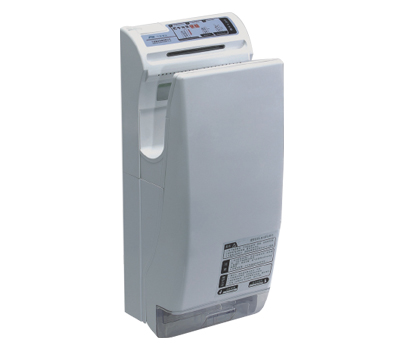
- ABS Plastic or Polycarbonate: Lightweight, easy to mold into complex, ergonomic shapes, and highly cost-effective. Requires UV-stabilized grades to prevent yellowing over time.
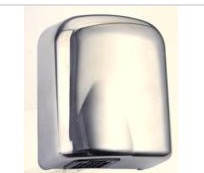
- 304 Stainless Steel (Drawn or Welded): The standard for heavy-duty commercial environments. Thickness usually ranges from 1.2mm to 1.5mm. Specifying the correct grade is crucial, as lower-grade 201 stainless steel will pit and rust in humid washroom environments.
| Feature | Economy / Standard | High-Traffic / Premium |
|---|---|---|
| Motor Type | Brushed DC (up to 20k RPM) | Brushless DC (up to 35k RPM) |
| Drying Time | 15 to 25 seconds | 7 to 10 seconds |
| Airspeed | 40 to 60 m/s | 90 to 110 m/s |
| Expected Lifespan | Approx. 1,000 hours | Over 3,000 hours |
Need help identifying manufacturers capable of producing custom brushless hand dryer models? We can match you with the right factory.
Talk to our teamManufacturing Quality and Inspection Points
Hand dryers operate in wet, high-humidity environments, making electrical safety and sensor reliability paramount. Subpar assembly often leads to hypersensitive infrared (IR) sensors, water ingress, or premature heating element failure.
Conducting rigorous quality control at the factory level—both during production and pre-shipment—is non-negotiable.
Critical Factory QC Checkpoints
- Dielectric Withstand (Hi-Pot) Testing: Ensures insulation integrity to prevent electric shock.
- IR Sensor Calibration: Verifies activation distance (typically 10-15cm) and prevents ghost-triggering from ambient light or reflections.
- IP Rating Verification: Confirms casing seals meet IPX1 to IPX4 standards for water ingress protection.
- Heating Element Thermal Cut-off: Tests the bimetallic thermostat to ensure the unit shuts down if airflow is blocked, preventing fire risks.
- Acoustic Chamber Testing: Measures decibel output at 1 meter to ensure compliance with specified noise limits (e.g., under 75 dB).
Compliance and Certifications
Because they draw significant current (often 1,000W to 1,800W) and are installed in wet zones, hand dryers face strict regulatory hurdles. Depending on your target market, units must pass CE (LVD/EMC), RoHS, UL/cUL, or CB scheme testing. Relying on a supplier's existing certificates is risky; verifying their validity through proper compliance and testing protocols ensures your shipment won't be held at customs.
Purchasing Mechanics: MOQ, Lead Times, and Pricing
Understanding factory constraints helps in structuring realistic procurement schedules and negotiating unit costs. Most specialized hand dryer manufacturers are clustered in Zhejiang and Guangdong provinces.
Tooling for completely custom external casings (ODM) significantly alters these timelines. A new injection mold for an ABS casing can take 35 to 50 days to complete, plus an additional 30 days for mass production. Proper factory audits are highly recommended before investing in custom tooling to ensure the supplier has the financial stability and engineering capability to execute the project.
Streamline your supply chain. Let us handle supplier vetting, negotiation, and quality control for your next order.
Get a free consultationFrequently Asked Questions
Sourcing commercial hand dryers at scale requires a deep understanding of electromechanical specifications and rigorous oversight of factory quality systems. By focusing on motor technology, casing integrity, and strict electrical safety compliance, buyers can secure reliable, high-margin products that perform flawlessly in the field.
Get Sourcing Help for Hand Dryers
Tell us your requirements and our experts will connect you with verified manufacturers.