Glass Candle Holders, Lanterns & Candle Jars
Source premium glass candle holders, lanterns, and candle jars from vetted manufacturers and wholesale suppliers. Designed for importers, distributors, and home decor brands seeking reliable OEM/ODM production, our factory-direct network ensures consistent quality, strict thermal compliance, and scalable bulk capacity.
Sourcing glass candle holders and jars in bulk requires balancing complex aesthetic finishes with non-negotiable thermal safety requirements. A visually stunning electroplated lantern or frosted jar is a liability if the glass shatters under the localized heat of a burning wick. For high-volume buyers, successful procurement hinges on selecting the correct manufacturing process, specifying the right glass composition, and ensuring rigorous annealing protocols at the factory level.
Manufacturing Methods and Material Selection
The production method dictates your tooling costs, minimum order quantities (MOQs), and the structural limitations of your design. Standard candle glass is typically made from soda-lime glass, which is cost-effective and offers sufficient clarity. For high-end applications or extreme thermal requirements, borosilicate glass is specified, though it carries a higher unit cost.
| Production Method | Best For | Tooling Cost | Typical MOQ |
|---|---|---|---|
| Machine-Pressed | Thick-walled jars, heavy bases, textured exteriors | High | 30,000 to 50,000 pcs |
| Machine-Blown | Thin-walled lanterns, smooth globes, uniform shapes | Medium-High | 20,000 to 30,000 pcs |
| Hand-Blown / Semi-Auto | Artisan designs, oversized lanterns, custom shapes | Low | 1,000 to 3,000 pcs |
When developing custom shapes, machine-made processes require substantial iron molds and continuous furnace operation, driving up the MOQ. If you are launching a new private-label line with unproven volume, starting with hand-blown or semi-automatic production before scaling to fully automated lines is often the most capital-efficient strategy.
Need help matching your product design to the most cost-effective manufacturing process?
Talk to our teamThermal Safety and Quality Control
The most critical failure point in glass candle containers is residual stress. When glass cools too quickly after forming, internal stresses remain. Once a consumer lights a candle, the heat differential can cause the glass to crack or explode.
Proper annealing—passing the glass through a temperature-controlled kiln (lehr) to cool it slowly and evenly—is mandatory. However, not all factories maintain their lehrs properly or run the process for the required duration to save on energy costs. Implementing rigorous Quality Control & Inspection is essential to catch these invisible defects before shipment.
Critical QC Checks for Candle Glass
- Polariscope testing: Verifies the absence of residual stress from improper annealing.
- Thermal shock testing: Ensures the glass can withstand a sudden temperature differential (typically a delta of 50 to 60 degrees Celsius minimum).
- Wall thickness uniformity: Prevents localized heat concentration which leads to cracking.
- Cross-cut adhesion testing: Verifies that sprayed, frosted, or electroplated finishes will not peel or flake.
Custom Finishes and OEM/ODM Development
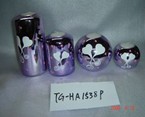
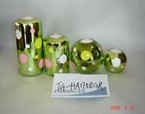
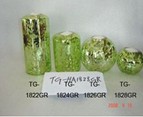
The aesthetic differentiation of candle vessels relies heavily on post-processing. Factories offer a wide range of secondary finishes, including color spraying (water-based or solvent-based), electroplating, ion plating, frosting, and decal application.
When utilizing OEM/ODM Services to develop custom finishes, you must specify the exact Pantone colors and finish types in your tech pack. Be aware that some finishes, particularly certain metallic electroplating techniques, can act as insulators or reflectors, trapping heat inside the jar and altering the candle's burn dynamics. Always test your final finish samples with your actual wax and wick configuration.
Pricing Drivers, MOQs, and Lead Times
Unit costs in glass manufacturing are highly sensitive to volume and factory specialization. A facility optimized for automated, continuous runs of standard 8oz candle jars will offer aggressive pricing but will firmly reject orders under their furnace minimums. Conversely, a factory specializing in decorative, hand-blown lanterns will accept lower MOQs but at a premium unit price.
Before committing to tooling costs, it is highly recommended to conduct comprehensive Factory Audits. Many suppliers listed on B2B directories are trading companies rather than direct manufacturers. An audit verifies actual furnace capacity, annealing equipment, and environmental compliance for secondary finishing lines.
Planning a high-volume glassware order and need accurate tooling and unit cost projections?
Get a free consultationFrequently Asked Questions
Navigating the glass candle holder supply chain requires more than just finding an attractive design; it demands strict oversight of thermal safety and production scalability. By defining clear material specifications and enforcing rigorous testing protocols, you protect your brand from quality failures and build a reliable foundation for high-volume growth.
Get Sourcing Help for Glass Candle Holders, Lanterns & Candle Jars
Tell us your requirements and our experts will connect you with verified manufacturers.