Gas Meters
Source commercial and industrial gas meters directly from vetted manufacturers and wholesale suppliers. Designed for importers, distributors, and brands seeking reliable OEM and private-label production, our network delivers precision flow measurement solutions built for strict regulatory compliance and high-volume deployment.
Sourcing gas meters in volume requires navigating a complex matrix of fluid dynamics, pressure ratings, and stringent safety certifications. Whether you are procuring traditional diaphragm meters for residential networks or high-capacity ultrasonic units for industrial applications, success hinges on a supplier's technical capability, precision calibration, and rigorous quality assurance.
Core Specifications for Bulk Procurement
When negotiating with manufacturers, specifying the correct operational parameters is critical to ensuring the meters perform accurately in their target environment. Small misalignments in specifications can lead to calibration drift or outright failure in the field.
- Flow Rate Capacity (Qmax, Qmin, Qn): Meters are typically classified by their nominal flow rate (e.g., G4, G6, G10). You must define the maximum flow rate (Qmax) the meter can handle without losing accuracy, and the minimum flow rate (Qmin) at which it registers movement.
- Operating Pressure: Standard residential meters often operate at low pressures (under 0.5 bar), while industrial rotary or turbine meters must handle medium to high pressures. Specify the maximum working pressure (Pmax) and ensure the casing material is rated accordingly.
- Accuracy Class: Most utility-grade meters require Class 1.5 or Class 1.0 accuracy. Ensure the factory's testing benches are certified to measure these tolerances across the entire flow range.
- Smart Integration & Telemetry: For smart gas meters, define the communication protocol (NB-IoT, LoRaWAN, M-Bus, or RS485). The internal battery life (typically 10 years) and the specific frequency bands for your target region must be confirmed before production.
| Meter Technology | Typical Application | Primary Sourcing Challenge |
|---|---|---|
| Diaphragm | Residential / Light Commercial | Consistent synthetic rubber quality to prevent hardening. |
| Rotary | Commercial / Industrial | Machining precision of the impellers to minimize pressure drop. |
| Ultrasonic | High-Volume Industrial / Custody Transfer | Transducer reliability and signal processing accuracy. |
Manufacturing Quality & Defect Prevention
The structural integrity and long-term accuracy of a gas meter are won or lost on the factory floor. Because these devices handle combustible gases, casing leaks are a catastrophic failure point. Many manufacturers use die-cast aluminum or stamped steel. Poor casting processes can result in micro-porosity in the aluminum, leading to slow leaks over time.
Implementing robust quality control and inspection protocols is non-negotiable. Pre-shipment inspections must include pressure decay testing and helium leak detection on a statistically significant sample size.
Critical Factory-Level Quality Checks
- Helium leak testing on 100 percent of assembled casings.
- Verification of synthetic diaphragm flexibility and chemical resistance.
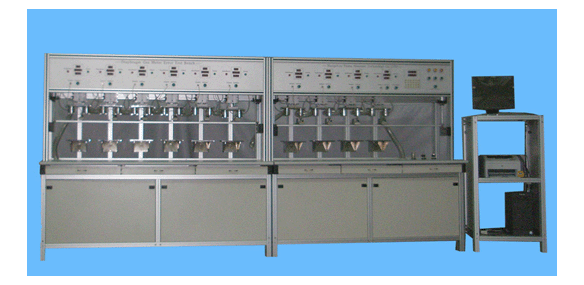
- Calibration verification across Qmin, 0.2 Qmax, and Qmax on certified test benches.
- Conformal coating inspection on PCBs for smart meters to prevent moisture damage.
Ensure your gas meters meet strict accuracy and safety standards before they ship. Let our engineers manage your factory vetting and quality control.
Talk to our teamCertifications and Regulatory Compliance
Gas meters are heavily regulated measuring instruments. Sourcing from a factory that claims compliance is not enough; you must verify their documentation and testing capabilities.
Key standards include OIML R 137 for gas meters, the Measuring Instruments Directive (MID 2014/32/EU) for the European market, and ATEX directives for equipment operating in explosive atmospheres. Verifying these credentials often requires on-site factory audits to ensure the manufacturer maintains the necessary ISO 17025 certified laboratory equipment to conduct ongoing batch testing. If you are customizing a meter for a specific market, comprehensive compliance and testing must be factored into your development timeline.
MOQs, Lead Times, and Pricing Dynamics
Pricing for gas meters is primarily driven by the casing material (aluminum vs. steel weight), the precision of the internal measuring unit, and the addition of smart communication modules.
If you are developing a proprietary smart meter or require specific branding, engaging in OEM/ODM services will involve upfront tooling costs for the casing and custom PCB design. Expect lead times to extend by 30 to 45 days during the initial prototyping and certification phases.
Need to negotiate better terms or develop a custom smart gas meter? We manage the entire sourcing lifecycle from factory selection to final delivery.
Get a free consultationFrequently Asked Questions
Procuring gas meters at scale demands technical precision and a deep understanding of the regulatory landscape. By partnering with vetted manufacturers and enforcing strict quality assurance protocols, you can secure reliable, compliant flow measurement solutions that perform flawlessly in the field.
Get Sourcing Help for Gas Meters
Tell us your requirements and our experts will connect you with verified manufacturers.