Filing Cabinets
Source commercial-grade filing cabinets from vetted manufacturers and suppliers across Asia's top steel furniture hubs. Designed for importers, wholesalers, and brands seeking reliable OEM/ODM production, our selection covers high-volume procurement needs with strict adherence to international commercial standards.
Sourcing commercial steel filing cabinets at scale is an exercise in managing raw material costs, structural precision, and shipping density. As a staple of office furniture procurement, the margin for error is slim: underspecified steel leads to buckling under load, poor surface treatment results in premature rust, and imprecise stamping makes assembly impossible.
For professional buyers, success relies on specifying the correct tolerances upfront and ensuring the factory's production lines can deliver consistent quality across high-volume container runs.
Core Specifications: Steel, Slides, and Security
The lifespan of a filing cabinet is dictated by its raw materials and hardware. Standard commercial units are manufactured from SPCC (Cold-Rolled Carbon Steel). When specifying thickness, buyers must clarify whether the measurement is for "bare steel" or "coated steel," as powder coating adds roughly 0.1mm to the final thickness.
| Application | Bare Steel Thickness | Hardware & Features |
|---|---|---|
| Budget / Light Office | 0.4mm - 0.5mm | Standard slides, basic cam lock |
| Standard Commercial | 0.6mm - 0.7mm | 3-section full extension ball-bearing slides, anti-tilt |
| Heavy Duty / Industrial | 0.8mm - 1.0mm+ | Heavy-duty slides (45kg+ capacity), central locking |
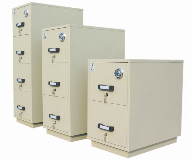
Beyond the steel gauge, the suspension system is the most critical failure point. Commercial units require three-section full-extension ball-bearing slides to allow full access to the drawer while supporting heavy paper loads. Additionally, multi-drawer units must feature an interlocking anti-tilt mechanism, ensuring only one drawer can be opened at a time to prevent the unit from tipping over.
Struggling to standardize specs across different suppliers? We can help you establish clear technical requirements and find factories that meet them.
Talk to our teamManufacturing Tolerances and Quality Control
The majority of steel office furniture in China is produced in specialized hubs, most notably Luoyang in Henan province. While the concentration of suppliers here offers competitive pricing, factory capabilities vary wildly.
High-end manufacturers utilize automated laser cutting, CNC bending, and closed electrostatic powder coating lines. Lower-tier workshops rely on manual stamping and open-air spray booths, leading to inconsistent panel alignment and coating defects. Conducting rigorous Factory Audits is essential to verify a supplier's machinery and pre-treatment processes before placing a volume order.
Critical Inspection Points
During Quality Control & Inspection, your inspection team should verify the following:
Pre-Shipment Inspection Checklist
- Phosphating and Acid Washing: Verify pre-treatment was completed properly to prevent sub-surface rust.
- Coating Adhesion: Perform a cross-cut test on the powder coating to ensure it does not flake or peel.
- Anti-Tilt Verification: Fully load the top drawer and confirm the interlock mechanism prevents other drawers from opening.
- Assembly Tolerances: For Knock-Down (KD) units, assemble a random sample to check for misaligned screw holes or warped panels.
- Slide Cycle Testing: Ensure drawers open smoothly without grinding or catching when fully loaded.
Knock-Down (KD) vs. Fully Assembled Structures
Shipping density is a primary cost driver for filing cabinets. Fully assembled cabinets consume massive amounts of container space, driving up the landed cost per unit.
To combat this, most bulk importers source Knock-Down (KD) structures. A KD cabinet ships flat-packed, allowing you to fit three to four times as many units into a 40HQ container. However, KD structures require exceptionally precise stamping and bending at the factory level. If the tolerances are off by even a millimeter, the end-user will struggle to assemble the unit, leading to high return rates. If you are developing custom configurations, utilizing professional OEM/ODM Services ensures your KD designs are engineered for both structural integrity and intuitive assembly.
Typical MOQs, Pricing, and Lead Times
Because production relies on continuous automated lines for stamping and powder coating, manufacturers require sufficient volume to justify machine setup and color changeovers.
Pricing fluctuates based on the global steel index. When negotiating long-term contracts, it is common to tie pricing to raw material costs. Custom powder coat colors (beyond standard grey, black, and white) or custom hardware will typically increase both the MOQ and the lead time.
Need to optimize your container loading or negotiate better volume pricing? Let our sourcing experts manage the factory negotiations.
Get a free consultationFrequently Asked Questions
Optimizing a filing cabinet supply chain means mastering the balance between raw material gauge and shipping efficiency. By prioritizing factories with automated KD production lines and strict pre-treatment protocols, buyers can secure reliable, commercial-grade storage solutions that protect their margins and their end-users.
Get Sourcing Help for Filing Cabinets
Tell us your requirements and our experts will connect you with verified manufacturers.