Electronic toothbrush
Source premium electronic toothbrushes from vetted suppliers and manufacturers across Asia. Designed for importers, distributors, and brands seeking reliable wholesale purchasing or custom OEM/ODM production, this catalog features high-performance oral care devices ready for bulk order and private labeling.
Sourcing electronic toothbrushes at scale requires balancing motor durability, battery safety, and strict waterproofing standards. For volume buyers and brands, the challenge isn't just finding a factory with an attractive design—it's ensuring consistent assembly quality, component reliability, and regulatory compliance across thousands of units.
Critical Specifications for Volume Buyers
The performance and market positioning of an electronic toothbrush are dictated by its internal architecture. When evaluating suppliers, buyers must specify the exact motor and battery technologies rather than relying on external aesthetics.
Motor Technology
The motor drives the cleaning action and represents the primary cost driver. Modern devices generally use one of two motor types:
| Motor Technology | Vibration Frequency | Noise Level | Durability |
|---|---|---|---|
| Magnetic Levitation (Sonic) | 31,000 to 42,000 VPM | Under 50dB | High (3 to 5 years) |
| Standard Eccentric Rotor | 8,000 to 15,000 VPM | 60dB or higher | Low to Medium |
Premium sonic toothbrushes utilize magnetic levitation (maglev) motors, which transfer kinetic energy directly to the brush head with minimal mechanical friction. This results in higher vibrations per minute (VPM), lower noise, and longer operational life.
Battery and Power Architecture
Lithium-ion (Li-ion) batteries are the industry standard, typically ranging from 600mAh to 2000mAh. A 1000mAh battery paired with an efficient maglev motor should yield 30 to 45 days of use on a single charge. Ensure your supplier provides full UN38.3 and MSDS documentation for the battery cells, as this is mandatory for international air and ocean freight.
Need help verifying a supplier's motor and battery specifications? Our engineering team can validate factory claims before you commit to an order.
Discuss your product specsManufacturing Vulnerabilities and Quality Control
Electronic toothbrushes operate in wet environments and endure daily mechanical stress. Manufacturing defects often remain hidden inside the casing until the product reaches the end user. Implementing rigorous quality control during assembly is non-negotiable.
Waterproofing Integrity
IPX7 (submersion in 1 meter of water for 30 minutes) is the baseline standard for electronic toothbrushes. Failures usually occur at the motor shaft seal, the button interface, or the bottom charging cap. High-quality factories use ultrasonic welding for the chassis and apply conformal coating to the Printed Circuit Board (PCB) to protect against micro-moisture ingress.
Bristle Tufting and End-Rounding
The brush head is a class I medical device component in many jurisdictions. High-density tufting using recognizable filament brands (like DuPont or Pedex) is expected.
The End-Rounding Standard
Unpolished bristles cause enamel wear and gum bleeding. Premium suppliers achieve an end-rounding rate of 85% or higher. Lower-tier factories often skip this polishing step to save time, resulting in rates under 50%. Always require end-rounding verification in your quality control checklist.
Pre-Shipment Inspection Focus Areas
- IPX7 vacuum water pressure testing on a statistical sample
- Microscopic verification of bristle end-rounding percentages
- Battery aging and charge-cycle testing
- Acoustic testing to ensure noise levels remain under 55dB
- Drop testing from 1 meter to verify internal motor mounts
Thorough factory audits are essential to verify that a manufacturer has the testing equipment—such as vacuum tanks for IPX certification and decibel meters—actually operational on their floor, rather than just for show.
OEM/ODM Customization
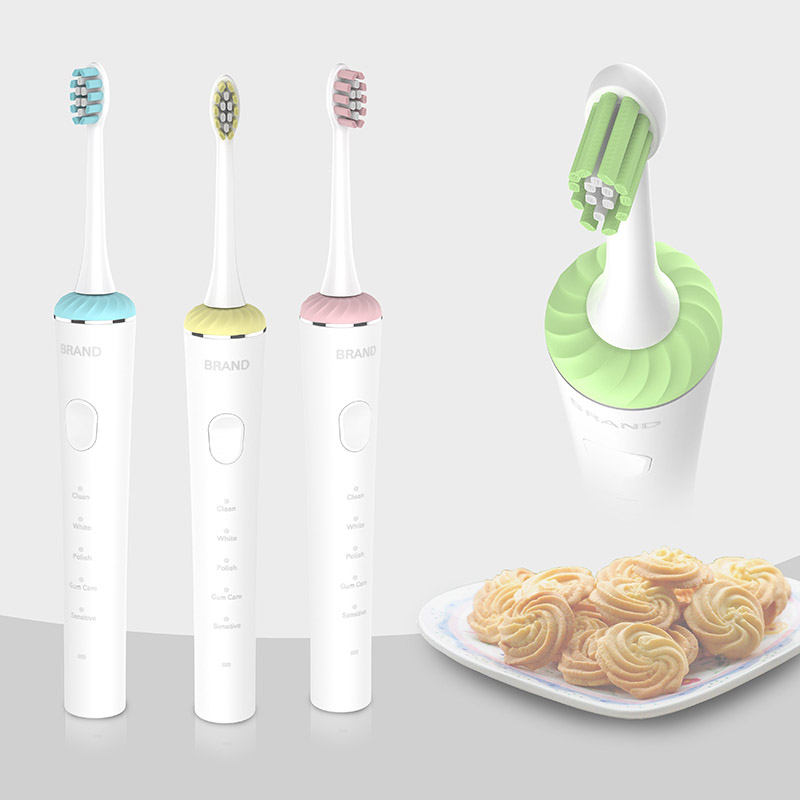
Most buyers utilize OEM/ODM services to customize existing factory molds. Private labeling involves applying your brand to the handle, customizing the packaging, and selecting specific brushing modes (e.g., Clean, Sensitive, Whitening).
For fully custom ODM projects, expect to invest in new injection molds for the handle and custom PCB programming for proprietary brushing algorithms. Ensure the factory has an experienced in-house R&D team capable of fine-tuning the motor frequency to match your specific brush head mass.
MOQs, Pricing, and Lead Times
Pricing is highly elastic based on motor type, battery capacity, and smart features (such as Bluetooth connectivity or pressure sensors).
When negotiating, clarify whether the quoted price includes the brush heads (and how many per unit), the charging base (inductive vs. direct Type-C), and retail packaging.
Looking to negotiate better terms or manage a complex OEM toothbrush project? We handle supplier communication, pricing leverage, and production oversight.
Talk to our teamFrequently Asked Questions
Successfully sourcing electronic toothbrushes requires looking past the outer shell to understand the mechanics, battery safety, and assembly precision. By defining strict technical specifications and enforcing rigorous quality control, buyers can secure reliable products that build brand trust and minimize costly returns.
Get Sourcing Help for Electronic toothbrush
Tell us your requirements and our experts will connect you with verified manufacturers.