Electronic Organizers
Source premium electronic organizers from vetted suppliers and manufacturers across Asia. Designed for importers, distributors, and consumer tech brands, our network supports bulk wholesale orders and custom OEM/private-label production to meet your exact specifications and quality standards.
Sourcing electronic organizers at scale requires navigating the intersection of consumer electronics accessories and traditional cut-and-sew manufacturing. While the product concept is straightforward, executing a bulk order that delivers consistent durability, precise interior layouts, and flawless zipper operation demands tight control over material selection and factory-floor assembly.
Material Specifications and Structural Design
The perceived value and functional lifespan of a tech pouch or cable organizer rely heavily on fabric choice, padding, and hardware. Buyers must specify denier, backing coatings, and zipper standards clearly in their tech packs; leaving these open to factory interpretation often results in margin-optimized, inferior substitutions.
When developing a product line, the primary structural decision is between soft-shell fabrics and molded hard cases.
| Design Type | Soft Shell (Nylon/Polyester) | Hard Shell (EVA) |
|---|---|---|
| Primary Application | Everyday carry, flexible capacity, travel | Impact protection, fragile components (hard drives) |
| Common Materials | 300D to 1200D Nylon/Poly, PU coated | Molded EVA foam with spandex or nylon outer |
| Tooling & Setup | Low (pattern cutting, standard dies) | Moderate to High (custom aluminum molds) |
| Interior Flexibility | High (layered mesh, varied elastics) | Moderate (often relies on molded inserts) |
For soft-shell designs, 600D polyester with a polyurethane (PU) backing is the industry standard for a balance of cost and durability. Premium lines typically upgrade to 1000D Cordura or high-density ballistic nylon for enhanced abrasion resistance.
Hardware Specifications
Zippers are the most common point of failure in electronic organizers. Always specify the zipper brand and gauge (e.g., YKK or SBS, #5 reverse coil). Unbranded zippers often bind around tight corners, leading to high return rates.
Need help finalizing your bill of materials and finding a capable manufacturer?
Talk to our teamManufacturing Challenges and Quality Control
Unlike injection-molded plastics, electronic organizers are labor-intensive sewn goods. Production consistency depends entirely on the skill of the sewing operators and the factory's inline inspection processes. When evaluating a supplier, it is critical to verify their actual production capacity and equipment through rigorous Factory Audits rather than relying solely on showroom samples, which are often produced by a master sample-maker.
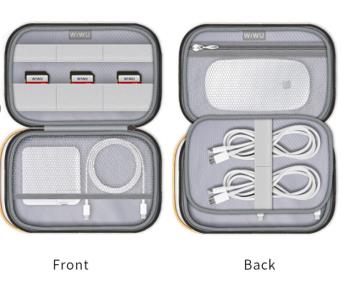
The complexity of an organizer lies on the inside. Multiple overlapping layers of mesh, varying sizes of elastic bands for cables, and internal zipper pockets require precise alignment.
To maintain standards, your Quality Control & Inspection protocols should focus on specific failure points inherent to complex sewn goods:
Critical QC Checkpoints for Organizers
- Seam Allowances: Check for adequate fabric bite to prevent seams from pulling apart under tension.
- Elastic Tension: Verify that woven elastics have excellent memory and do not over-stretch after initial use.
- Zipper Operation: Test all zippers around corners to ensure smooth action without catching the inner lining.
- Stitching Density: Ensure a minimum of 8 to 10 stitches per inch (SPI) on load-bearing seams.
- Material Backing: Inspect the PU coating for flaking or inconsistent application.
OEM/ODM Customization and Branding
For brands looking to develop private-label lines, utilizing OEM/ODM Services allows for complete control over the interior layout. Tech trends shift rapidly; an organizer designed three years ago may have SD card slots that are no longer relevant, or lack the depth required for modern high-wattage GaN chargers.
Customizing the exterior branding also requires coordination. While woven labels are cost-effective and durable, modern tech brands often prefer silkscreen printing, heat transfer logos, or debossed PU leather patches. If your product is destined for retail shelves, aligning the product design with your Branding & Design strategy—including custom hangtags, belly bands, or rigid gift boxes—is essential for a cohesive presentation.
Pricing, MOQs, and Production Realities
Understanding the cost drivers in this category will help you negotiate effectively and plan your inventory cycles.
The primary drivers of unit cost are:
- Interior Complexity: Every additional mesh pocket, zipper, or elastic loop adds separate cutting and sewing steps, directly increasing labor costs.
- Material Upgrades: Moving from unbranded hardware to YKK zippers, or from standard polyester to recycled rPET fabrics, will noticeably impact the bill of materials.
- Packaging: Upgrading from standard polybags to custom retail packaging adds both material cost and volumetric weight for shipping.
Ready to optimize your supply chain and negotiate better terms?
Get a free consultationFrequently Asked Questions
Success in sourcing electronic organizers comes down to treating them as precision sewn goods rather than generic promotional items. By tightly controlling your material specifications and enforcing strict inline inspections, you can deliver a premium product that protects high-value tech reliably.
Get Sourcing Help for Electronic Organizers
Tell us your requirements and our experts will connect you with verified manufacturers.