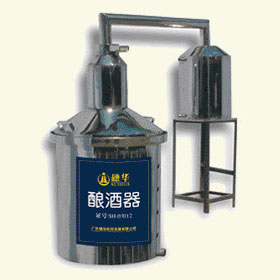
Distillation Equipment
Source commercial and industrial distillation equipment directly from vetted manufacturers and suppliers. Designed for importers, wholesalers, and beverage brands seeking OEM production, our network provides bulk access to high-grade extraction and refining systems built to exacting international standards.
Sourcing commercial distillation equipment demands strict adherence to sanitary and pressure vessel standards. Whether you are outfitting craft beverage facilities or scaling industrial alcohol processing lines, the difference between a high-yield, compliant system and a costly liability lies entirely in the manufacturer's engineering capabilities, metallurgical sourcing, and welding precision.
Material Specifications and Sanitary Design
When specifying beverage and wine processing machinery, material selection drives both performance and cost. Copper (typically C11000 or T2) is critical for vapor interaction and sulfur reduction in spirit distillation. Stainless Steel (SUS304 or 316L) provides the structural integrity and corrosion resistance required for boilers, condensers, and CIP (Clean-in-Place) piping networks.
Manufacturers must be able to verify material purity. Substituting lower-grade copper or failing to use 316L in high-acidity zones will lead to rapid degradation and product contamination.
| Component | Standard Material | Premium / High-Corrosion Material |
|---|---|---|
| Boiler / Kettle | SUS304 Stainless Steel | SUS316L or T2 Copper |
| Distillation Columns | SUS304 with Copper Plates | 100% T2 Copper |
| Condensers | SUS304 Tube & Shell | SUS316L Tube & Shell |
| CIP Piping | SUS304 | SUS316L |
Need to verify a manufacturer's metallurgical sourcing and pressure vessel certifications before placing an order?
Talk to our teamManufacturing Tolerances and Defect Control
The true test of a distillation equipment factory is its welding and finishing capabilities. Because these systems operate under pressure and high temperatures, structural integrity is non-negotiable. Sanitary welds must be TIG-welded, back-purged with argon, and completely free of pits, crevices, or oxidation that could harbor bacteria.
Internal surfaces requiring food-grade compliance typically mandate a surface finish (Ra) of under 0.4 micrometers. Catching incomplete weld penetration, porosity, or improper polishing requires rigorous Quality Control & Inspection before the equipment leaves the factory floor.
Critical Factory-Floor QC Checks
- Hydrostatic pressure testing of steam jackets (typically tested at 1.5x working pressure).
- Positive Material Identification (PMI) to confirm copper and stainless steel grades.
- Visual and penetrant testing of all sanitary welds for porosity or micro-cracking.
- Surface roughness (Ra) measurement on all internal product-contact surfaces.
- Agitator motor and gearbox alignment verification to prevent seal wear.
Custom Configurations and Automation
Scaling production often requires custom plate counts, specific bubble cap designs, or the integration of PLC automation (such as Siemens or Allen-Bradley systems) for precise temperature and flow control. Executing these complex builds requires manufacturers with robust OEM/ODM Services and in-house engineering teams, rather than simple assembly workshops.
Buying Mechanics: MOQs, Pricing, and Lead Times
Procuring industrial distillation systems is a capital-intensive process with extended timelines. Pricing is highly volatile, driven primarily by the global commodities market for copper and nickel (stainless steel), as well as the level of automation required.
Compliance certifications heavily influence cost and factory selection. If your market requires ASME U-stamp (for pressure vessels in North America) or CE PED (Pressure Equipment Directive for Europe), you must ensure the factory actually holds these credentials, not just standard ISO 9001. Validating these stamps and engineering capabilities requires comprehensive on-site Factory Audits.
Furthermore, shipping oversized columns and boilers often requires specialized flat racks or open-top containers. Coordinating breakbulk or out-of-gauge transport demands expert Shipping & Freight management to ensure the equipment arrives without transit damage.
Ensure your heavy equipment logistics, factory compliance, and custom engineering are handled flawlessly from end to end.
Get a free consultationFrequently Asked Questions
Procuring industrial distillation equipment requires balancing complex metallurgical requirements with strict pressure vessel safety standards. By thoroughly vetting a manufacturer's engineering capabilities and enforcing rigorous in-line quality control, buyers can secure high-performance systems that deliver decades of reliable operation.
Get Sourcing Help for Distillation Equipment
Tell us your requirements and our experts will connect you with verified manufacturers.