Blowers
Source industrial and commercial blowers from vetted Chinese manufacturers and suppliers. This catalog is designed for importers, wholesalers, distributors, and brands seeking reliable OEM and private-label production at scale. Compare wholesale pricing on high-performance ventilation and heat exchange equipment.
Industrial blowers are the driving force behind refrigeration, heavy-duty HVAC, and industrial heat exchange systems. Sourcing these units in bulk requires navigating a complex matrix of aerodynamic performance, motor efficiency standards, and long-term mechanical reliability. A miscalculation in static pressure or a compromised motor winding can lead to catastrophic system failure for your end-users.
Success in purchasing blowers directly from Asian manufacturers comes down to specifying exact tolerances and rigorously verifying component quality before assembly.
Critical Specifications for Blower Procurement
When negotiating with manufacturers, generic requests yield generic, often underperforming products. You must define the exact operating parameters to ensure the factory selects the correct housing geometry and motor pairing.
- Aerodynamic Performance: Specify the required Airflow (CFM or CMH) alongside the exact Static Pressure (Pa or inH2O) at the operating point. Blowers operate on a curve; a high CFM rating is meaningless if it drops to zero under the static pressure of your specific heat exchanger.
- Motor Efficiency & Voltage: Industrial markets increasingly mandate high-efficiency motors. Specify whether you require IE2, IE3, or IE4 efficiency classes. Ensure the factory winds the motors for your destination market's exact voltage and frequency (e.g., 460V/60Hz for North America vs. 380V/50Hz for Europe).
- Acoustic Requirements: Specify maximum allowable noise levels (dB) at a defined distance. Low-noise requirements often dictate specific impeller designs and heavier, vibration-dampening housings.
| Impeller Design | Pressure Characteristics | Typical Application |
|---|---|---|
| Forward-Curved | Low to Medium | Compact HVAC, low-pressure cooling |
| Backward-Curved | Medium to High | High-efficiency heat exchange, draft systems |
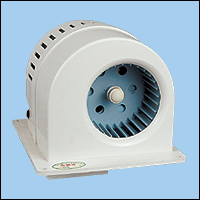
| Radial (Paddle) | Very High | Dust-laden air, heavy industrial exhaust |
Where Quality is Won and Lost on the Factory Floor
The difference between a blower that lasts ten years and one that fails in ten months is rarely visible from the outside. Chinese manufacturers offer a wide spectrum of quality, and price reductions usually come from invisible component downgrades.
Impeller Balancing and Vibration
Vibration is the primary enemy of any centrifugal or axial blower. If the impeller is not dynamically balanced to a strict standard (typically ISO 1940-1 Grade G6.3 or G2.5 for high-speed units), the resulting vibration will destroy the motor bearings prematurely.
Motor Windings and Bearings
Aggressive price negotiations often lead factories to substitute pure copper motor windings with Copper-Clad Aluminum (CCA). CCA runs hotter, is more prone to vibration fatigue, and drastically reduces the motor's lifespan. Similarly, generic domestic bearings are often swapped in place of premium brands. Always specify the exact bearing brand required (e.g., SKF, NSK, or NTN).
Blower Manufacturer Verification Checklist
- Verify dynamic balancing equipment and calibration records on the factory floor.
- Confirm pure copper windings via resistance testing, not just visual inspection.
- Check the supply chain for bearings to ensure they are sourcing genuine SKF/NSK parts.
- Inspect the housing welding and anti-corrosion coating processes (e.g., powder coating thickness).
To ensure these standards are met before committing to a large order, conducting comprehensive factory audits is standard practice for serious importers.
Need reliable manufacturers who don't cut corners on motor windings and impeller balancing? Let's discuss your sourcing requirements.
Talk to our teamCustomization and OEM Production
If you are integrating blowers into proprietary heat exchange equipment or developing a private-label line, standard off-the-shelf units rarely suffice.
When utilizing OEM/ODM services, you must specify environmental adaptations. For highly corrosive environments, specify stainless steel (304 or 316L) housings or specialized epoxy coatings. For high-temperature exhaust, specify heat-resistant bearings and ensure the motor is isolated from the primary airstream.
Buying Mechanics: MOQs, Pricing, and Lead Times
Blower manufacturing is highly scalable, but the economics depend entirely on the size and specialization of the unit.
Pricing is highly volatile and directly tied to global copper, steel, and aluminum indices. A sudden drop in a supplier's quoted price usually indicates a material substitution. Implementing rigorous quality control & inspection prior to shipment is the only reliable way to ensure the units you receive match the approved golden sample.
Struggling with inconsistent quality or rising costs from your current blower supplier? We can help stabilize your supply chain.
Get a free consultationFrequently Asked Questions
Sourcing industrial blowers requires a rigid, specification-driven approach. By locking down aerodynamic performance, enforcing strict motor and bearing requirements, and verifying dynamic balancing, you can secure highly reliable equipment at competitive wholesale price points.
Get Sourcing Help for Blowers
Tell us your requirements and our experts will connect you with verified manufacturers.