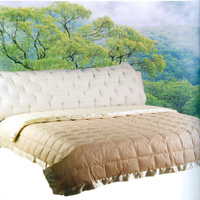
Bedspreads & Coverlets
Source premium bedspreads & coverlets from vetted manufacturers and suppliers in Asia. Designed for importers, wholesalers, and home textile brands, our network supports bulk wholesale orders and custom OEM/ODM production. Ensure consistent quality, precise stitching, and reliable delivery for your large-scale bedding programs.
Sourcing bedspreads and coverlets at scale requires strict control over fabric consistency, quilting precision, and dye lot uniformity. Unlike basic flat sheets, coverlets and bedspreads are multi-layered textiles. Whether you are developing lightweight summer coverlets or heavy jacquard bedspreads, the factory's capability to manage fabric tension during quilting and ensure colorfastness dictates the commercial viability of the final product.
Technical Specifications & Material Selection
When defining your product for overseas manufacturers, precise specifications are non-negotiable. The outer shell, the fill (batting), and the binding must all be specified independently to avoid supplier assumptions that lead to cost-cutting.
- Shell Fabric: Common materials include 100% cotton (percale or sateen weaves, typically 200 to 400 thread count), washed linen, and polyester microfiber (usually 70 to 110 GSM).
- Fill Material: Coverlets are traditionally lightweight. Specify the batting weight in GSM (Grams per Square Meter). A standard summer coverlet uses 80 to 120 GSM needled polyester or a cotton-poly blend to prevent the fill from shifting or clumping after washing.
- Finishing: Pre-washing or enzyme washing is critical for cotton and linen coverlets to achieve a soft hand-feel and to pre-shrink the fabric before it reaches the end consumer.
Ensure your next bedding production run meets strict quality and specification standards from day one.
Talk to our textile expertsManufacturing Processes: Quilting Techniques
The quilting method is the primary driver of both aesthetic appeal and production cost. Selecting the right method depends on your target price point and fabric composition.
| Quilting Method | Best For | Cost Impact | Technical Note |
|---|---|---|---|
| Multi-Needle Machine | High-volume geometric patterns | Low to Medium | Fastest production; requires precise tension control to avoid puckering. |
| Single-Needle (Computerized) | Complex, custom motifs | High | Slower output; allows for intricate, non-continuous designs. |
| Ultrasonic (Pinsonic) | 100% Synthetic fabrics (Polyester) | Lowest | Uses heat friction instead of thread to fuse layers; zero thread breakage risk. |
When evaluating a new supplier, it is highly recommended to conduct thorough Factory Audits to verify the age and maintenance of their quilting machinery, as older multi-needle machines often suffer from tension inconsistencies.
Quality Control in Bedspread Production
Defects in bedspreads are highly visible. Because they drape over the entire bed, any asymmetry in the pattern or uneven hemming will result in retail returns. Implementing strict Quality Control & Inspection protocols during the inline and pre-shipment phases is essential.
Critical QC Checks for Bedspreads
- Dimensional stability: Shrinkage must remain under 3 percent after standard washing.
- Stitching integrity: Check for skipped stitches, thread breakage, and uneven tension (puckering).
- Colorfastness: Must rate Grade 4 or higher for both washing and dry/wet rubbing.
- Binding and hemming: Corners must be neatly mitered with uniform width on all four edges.
- Fill migration: Batting must not poke through the shell fabric (fiber migration).
Pricing, MOQs, and Lead Times
Bedding factories operate on economies of scale, particularly when custom dyeing or printing is involved.
If you are purchasing off-the-shelf fabric colors (market available fabrics), suppliers can sometimes reduce MOQs to 200-300 pieces. However, for brands utilizing OEM/ODM Services to develop proprietary prints or unique jacquard weaves, mills will require higher minimums to justify setting up the looms or rotary screens.
Pricing is highly sensitive to raw material costs (cotton vs. polyester) and the complexity of the quilting. Oversized bedspreads (e.g., California King) also require wider fabric looms (often 110 to 120 inches wide), which limits the pool of capable suppliers and slightly increases the per-meter fabric cost.
Need accurate pricing, verified suppliers, and lead times for your custom coverlet program?
Get a sourcing assessmentFrequently Asked Questions
Successfully sourcing bedspreads and coverlets means looking past the surface design to understand the factory's technical capabilities in tension control, dyeing, and finishing. By partnering with a team that understands textile manufacturing from the yarn up, you can build a resilient supply chain that delivers consistent quality order after order.
Get Sourcing Help for Bedspreads & Coverlets
Tell us your requirements and our experts will connect you with verified manufacturers.