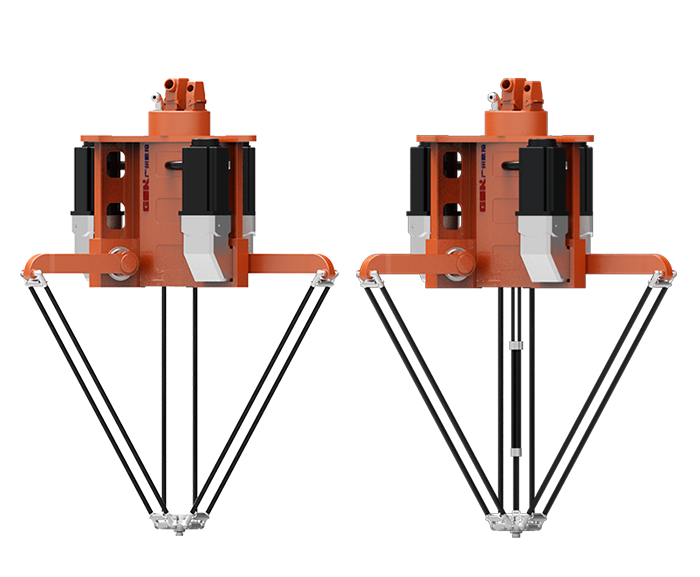
Parallel Robots
Source high-speed parallel robots from vetted suppliers and manufacturers across Asia. Designed for procurement managers, automation distributors, and OEM brands buying industrial robotics in volume, our platform connects you with factory-direct pricing for precision delta and hexapod systems.
Parallel robots—most commonly engineered as high-speed delta robots or heavy-duty hexapods—are the backbone of modern pick-and-place automation, packaging, and precision assembly. Sourcing these units directly from overseas manufacturers offers significant margin improvements for distributors and system integrators. However, the procurement process requires strict attention to kinematic precision, servo motor origins, and controller architecture to ensure the hardware performs reliably in continuous-duty, high-cycle environments.
Specifying Parallel Robots for Bulk Procurement
When negotiating with manufacturers, vague specifications lead to integration failures. Parallel robots rely on the precise coordination of multiple kinematic chains, meaning component tolerances are unforgiving. You must define the exact performance envelope required for your application.
| Specification | Standard Delta Robot | High-Speed Washdown Delta |
|---|---|---|
| Payload Capacity | 1kg to 3kg | 3kg to 8kg |
| Repeatability | ±0.1 mm | ±0.03 mm |
| Cycle Speed | 80 to 120 CPM | 150 to 200+ CPM |
| IP Rating | IP54 (Standard Industrial) | IP67 / IP69K (Food Grade) |
Critical Component Origins
The reliability of a parallel robot is heavily dependent on its drive components. Many Chinese manufacturers offer tiered pricing based on the origin of the servo motors and gearboxes.
- Tier 1 (Premium): Japanese or European servos (e.g., Yaskawa, Panasonic, Beckhoff) paired with high-precision harmonic drives. Essential for sub-millimeter repeatability.
- Tier 2 (Standard): Domestic Chinese servos (e.g., Inovance, Leadshine). These have improved dramatically and are highly cost-effective for standard packaging tasks with moderate precision requirements.
Need help verifying component origins and kinematic precision before placing a volume order?
Talk to our teamManufacturing Quality and Factory Floor Realities
A parallel robot's speed and accuracy degrade rapidly if the mechanical linkages are poorly manufactured. When evaluating a supplier, or conducting factory audits, focus heavily on the machining and assembly of the kinematic chains.
Critical Manufacturing Checkpoints
- Carbon Fiber Delamination: Inspect the bonding between the carbon fiber rods and the aluminum/titanium end fittings. Poor resin application leads to failure under high-G acceleration.
- Universal Joint Tolerances: Heim joints or spherical bearings must have zero backlash. Check the manufacturer's bearing supplier.
- Base Casting Rigidity: The stationary base must be CNC machined from a single casting to prevent flex during aggressive directional changes.
- Cleanroom Assembly: For high-precision or medical applications, verify the factory has certified cleanroom assembly lines to prevent particulate contamination in gearboxes.
Controller Architecture and Integration
The physical robot is only half the sourcing equation. The controller architecture dictates how easily the robot will integrate into your existing automation lines.
Many cost-effective manufacturers use proprietary, closed-loop controllers. While cheaper, these can be a nightmare for system integrators. Professional buyers should specify open-architecture controllers supporting standard industrial protocols like EtherCAT, PROFINET, or Modbus TCP. If you require the robot to be controlled directly by a central PLC (e.g., Allen-Bradley or Siemens) without a dedicated robot controller, you must explicitly negotiate this kinematic software integration with the factory upfront.
Pricing, MOQs, and Lead Times
Because parallel robots are capital equipment, Minimum Order Quantities (MOQs) are highly flexible. Most manufacturers will accommodate single-unit sample orders for testing, but true wholesale pricing requires volume commitments.
Customization—such as modifying the working envelope, applying food-grade coatings, or white-labeling the controller software—will increase both lead times and initial engineering costs.
Ready to negotiate volume pricing and custom OEM specifications with vetted robotics manufacturers?
Get a free consultationQuality Control and Compliance Standards
Never ship industrial robotics without rigorous pre-shipment testing. A standard visual inspection is insufficient. Comprehensive quality control and inspection must include a 24-to-48-hour continuous burn-in test at maximum payload and maximum speed to verify thermal stability in the servo motors and zero-drift in repeatability.
Furthermore, ensure the equipment meets your regional safety requirements. For the European market, this means verifying the factory's documentation for the CE Machinery Directive (MD) and Electromagnetic Compatibility (EMC). Engaging experts for compliance and testing ensures the robots arrive with valid, verifiable certification rather than self-declared paperwork.
Sourcing parallel robots at scale is an exercise in balancing kinematic performance with integration flexibility. By rigorously defining component origins and demanding strict burn-in testing, buyers can secure highly reliable automation hardware at competitive factory-direct prices.
Get Sourcing Help for Parallel Robots
Tell us your requirements and our experts will connect you with verified manufacturers.