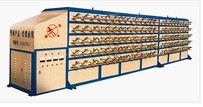
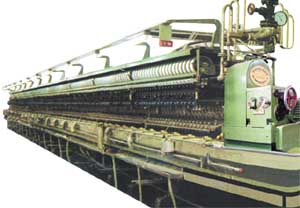
Winding Machines
Source industrial winding machines from vetted textile machinery manufacturers and suppliers. Designed for importers, distributors, and textile mills looking for bulk purchasing or OEM production. Find high-speed, precision-tension equipment to optimize yarn preparation and winding processes at scale.
Industrial textile winding machines are the critical bridge between spinning and downstream processes like dyeing, knitting, or weaving. The core sourcing challenge isn't just finding a machine that winds fast; it is securing equipment that maintains uniform yarn tension, consistent package density, and flawless yarn clearing at high speeds, all without excessive power consumption or maintenance downtime.
When buying in volume or commissioning custom machinery, success depends on strictly defining your technical requirements and verifying the manufacturer's component supply chain.
Critical Specifications for Your Purchase Order
A vague spec sheet leads to substandard machinery. Whether you are sourcing cone-to-cone, hank-to-cone, or assembly winders, your RFQ must explicitly detail the operational parameters. Manufacturers will default to their standard domestic configurations unless instructed otherwise.
- Spindle Count & Modularity: Machines are typically built in multiples of 12 or 24 spindles. Specify whether you need single-sided or double-sided frames.
- Winding Speed: Standard machines operate between 600 to 800 meters per minute (m/min), while high-speed variants can exceed 1200 m/min. Ensure the motor capacity matches the requested speed without overheating.
- Tension Control Mechanisms: This dictates the final package density. Mechanical tensioners are cheaper but less precise. Electronic tension control with closed-loop feedback is mandatory for soft winding (preparation for yarn dyeing).
- Traverse Length & Package Shape: Specify the required traverse (commonly 6 inches or 8 inches) and the conicity (e.g., 3 degrees 30 minutes, 4 degrees 20 minutes, or 5 degrees 57 minutes) to match your downstream equipment.
Need help standardizing technical specifications across multiple suppliers? Merhein can manage the technical dialogue.
Talk to our teamComponent Quality and Factory Assembly
The difference between a winding machine that runs reliably for a decade and one that suffers constant electrical faults lies in the bill of materials (BOM). Many manufacturers offer competitive pricing by substituting tier-one components with unbranded alternatives.
When negotiating OEM contracts, dictate the brands for critical components. Conducting rigorous factory audits before placing a deposit is the most reliable way to confirm the supplier actually uses the components they promised in their quotation.
| Sub-System | Standard/Budget Configuration | Premium/OEM Configuration |
|---|---|---|
| Drive Motors | Generic domestic AC motors | High-efficiency brushless DC (BLDC) motors |
| Inverters / PLC | Unbranded or tier-3 Chinese brands | Yaskawa, Delta, or Siemens |
| Yarn Clearers | Mechanical slit catchers | Optical or capacitive electronic clearers (e.g., Loepfe, Uster) |
| Anti-Patterning | Basic mechanical disruption | Advanced electronic anti-patterning software |
Quality Control and Pre-Shipment Inspection
Industrial machinery cannot be easily returned once it leaves the port of origin. Comprehensive quality control and inspection must occur on the factory floor while the machines are fully assembled and under power.
Winding Machine Factory Acceptance Test (FAT) Checklist
- Continuous Run Test: Operate the machine at maximum rated speed for a minimum of 4 hours to check for motor overheating.
- Noise and Vibration: Measure decibel levels and check frame stability; excessive vibration indicates poor drum balancing.
- Package Density Check: Weigh finished cones to ensure uniform density across multiple spindles.
- Electrical Safety: Verify grounding, emergency stop functionality, and compliance with destination market voltage (e.g., 380V/50Hz vs 440V/60Hz).
- Yarn Breakage Response: Test the auto-stop motion sensors on individual spindles.
Pricing, MOQs, and Logistics
Procuring heavy textile machinery involves significant capital expenditure and complex logistics. Prices vary drastically based on the level of automation (e.g., auto-doffing vs. manual doffing) and the spindle count per set.
Because winding machines are bulky and often require specialized crating to protect sensitive electronics and grooved drums from moisture and impact, coordinating shipping and freight early in the production cycle is essential to avoid port storage fees.
Managing heavy machinery logistics and customs clearance is complex. Let us handle the heavy lifting.
Get a free consultationFrequently Asked Questions
Sourcing industrial winding machinery is an exercise in total cost of ownership (TCO). A lower upfront price achieved by compromising on tension sensors or motor quality will be rapidly offset by production downtime and wasted yarn. Focus your negotiations on component transparency and rigorous pre-shipment testing to ensure your equipment performs exactly as required on day one.
Get Sourcing Help for Winding Machines
Tell us your requirements and our experts will connect you with verified manufacturers.