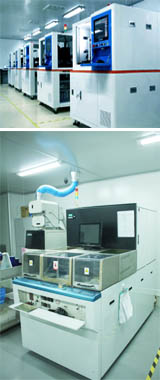
Wafer Grinding Machines
Source industrial wafer grinding machines from vetted manufacturers and suppliers in China and Asia. Designed for distributors, semiconductor equipment integrators, and procurement managers buying in volume. Secure reliable wholesale pricing, custom configurations, and verified factory quality for your production lines.
Sourcing semiconductor manufacturing equipment overseas requires navigating a narrow field of highly specialized suppliers. Wafer grinding machines demand extreme precision—often requiring sub-micron Total Thickness Variation (TTV) and rigid cleanroom compatibility. For procurement managers and equipment integrators, the primary sourcing challenge is verifying that a manufacturer's stated tolerances hold true under continuous, high-volume production loads, rather than just during a carefully controlled factory demo.
Critical Specifications for Wafer Grinding Equipment
When evaluating overseas manufacturers, the technical dialogue must immediately center on spindle performance, vibration dampening, and automation capabilities. Standardizing your RFQ with exact parameters prevents suppliers from quoting entry-level manual machines when your application requires cassette-to-cassette automation.
Material-Specific Configurations
The material being ground drastically alters the machine's required build. Silicon carbide (SiC), sapphire, and gallium nitride (GaN) require vastly different spindle torque and coolant delivery systems compared to standard silicon.
| Component | Standard Silicon Processing | SiC / Hard Material Processing |
|---|---|---|
| Spindle Power | Standard (3 to 5 kW) | High Torque (7+ kW) |
| Grinding Wheels | Resin-bond diamond | Vitrified or metal-bond diamond |
| Coolant Delivery | Standard DI water flow | High-pressure, precisely chilled |
| Base Casting | Cast iron or standard granite | High-mass natural granite |
Need help identifying manufacturers capable of building high-torque machines for SiC wafers? Let our engineering sourcing team narrow down the qualified factories.
Talk to our teamManufacturing Quality and Factory Verification
The core of a wafer grinder's accuracy lies in components that Chinese manufacturers often import. The best factories build the machine frame and software in-house but rely on Japanese or German air-bearing spindles and measurement gauges.
When conducting factory audits, you must verify the origin of these critical components. A supplier claiming high precision with unbranded domestic spindles presents a massive operational risk. Furthermore, the machine's base must be properly aged to prevent microscopic warping over time.
Factory Acceptance Test (FAT) Requirements
- Spindle Runout Verification: Must be measured dynamically at full operating RPM.
- TTV and Bow/Warp Testing: Grind a minimum batch of 25 test wafers to verify consistency.
- In-Process Gauge Calibration: Ensure thickness sensors match standalone metrology equipment.
- Cleanroom Compliance: Verify particle generation metrics match ISO class requirements.
If you cannot be on-site, implementing rigorous quality control and inspection protocols during the assembly and testing phases is non-negotiable. Catching a software integration error or a misaligned chuck before the machine is crated saves months of costly rework.
Pricing, Lead Times, and Logistics
Wafer grinding machines are capital equipment, rarely kept in stock. They are built to order based on your specific chuck size, automation needs, and target materials.
- Lead Times: Typical production times range from 60 to 120 days. High-automation models (integrating robotic arms and automated wafer handling) push lead times toward the higher end.
- Pricing Drivers: The inclusion of continuous in-process thickness measurement (contact or non-contact probes), dual-spindle designs (rough and fine grinding in one pass), and the origin of the CNC controller are the primary cost variables.
- Logistics: These machines are heavy, sensitive to vibration, and susceptible to moisture. They require specialized vacuum packing, shock-absorbing crates, and precise handling. Coordinating shipping and freight with forwarders experienced in heavy industrial machinery is essential to ensure the equipment arrives with its calibration intact.
Planning a capital equipment purchase? We manage the entire process, from supplier vetting and price negotiation to secure international logistics.
Get a free consultationFrequently Asked Questions
Sourcing semiconductor equipment from Asia offers significant cost advantages, but the margin for error is zero. Success requires looking past the glossy spec sheets to audit the factory's supply chain for critical components, enforcing strict FAT protocols, and managing the delicate logistics of heavy precision machinery.
Get Sourcing Help for Wafer Grinding Machines
Tell us your requirements and our experts will connect you with verified manufacturers.