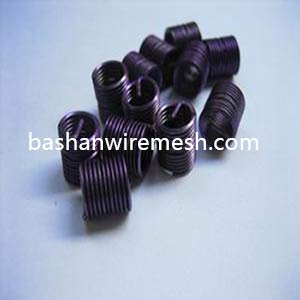
Thread Inserts
Source high-precision Thread Inserts from vetted manufacturers and suppliers across Asia. Built for importers, industrial distributors, and OEM brands buying in bulk, this catalog features reliable production partners capable of meeting strict tolerances and high-volume demands for custom and standard inserts.
Procuring thread inserts in commercial volumes requires strict attention to dimensional accuracy and material integrity. Whether you are sourcing wire-thread inserts for aerospace applications, self-tapping inserts for heavy machinery, or brass inserts for injection-molded plastics, the core challenge remains the same: ensuring consistent thread geometry and pull-out resistance across millions of units. A minor deviation in pitch diameter or material hardness can lead to assembly failures, stripped threads, and costly production halts on your end.
Critical Specifications for Bulk Procurement
When negotiating with manufacturers, vague specifications lead to inconsistent batches. Professional buyers must define exact parameters to ensure the factory understands the performance requirements.
- Material Grade: Specify the exact alloy. For stainless steel wire inserts, 304 (A2) and 316 (A4) are standard, but aerospace or high-temp applications may require Inconel or Nitronic 60. For plastics, specify the exact brass alloy (e.g., C3604) to ensure proper machinability and thermal conductivity during ultrasonic insertion.
- Thread Class & Tolerances: Define the required thread fit (e.g., Class 2B or 3B for unified threads, 6H for metric). The manufacturer must guarantee that the insert, once installed, will accept the corresponding bolt gauge without binding or excessive play.
- Surface Treatment: Bare metal is common, but dry-film lubricants, cadmium plating, or silver plating are often required to prevent galling in stainless-to-stainless applications.
- Locking Mechanisms: If sourcing locking inserts, specify the prevailing torque requirements and ensure the factory has the capability to consistently deform the locking coil or pre-assemble the locking keys.
Struggling with inconsistent thread tolerances from your current suppliers? Let us connect you with vetted precision fastener manufacturers.
Talk to our teamManufacturing Processes and Quality Control
The production method dictates the potential failure points. Wire-thread inserts are cold-rolled and coiled, meaning tension and wire profile control are paramount. Solid machined inserts (key-locking or self-tapping) rely heavily on CNC precision and tool wear management.
Relying solely on final inspections is risky. A robust Quality Control & Inspection protocol must verify parameters during production.
Factory Floor Quality Checks
- Wire Profile Verification: Ensuring the diamond shape of wire inserts matches the required thread angle perfectly before coiling.
- Go/No-Go Gauge Testing: Routine checks of the internal and external threads post-machining or post-coiling.
- Tang Break-Off Testing: Verifying the notch depth on wire inserts allows for clean tang removal without distorting the bottom thread.
- Plating Thickness: Using X-ray fluorescence (XRF) to ensure dry-film or silver coatings meet micrometer specifications without altering thread fit.
- Torque-Out and Pull-Out Tests: Destructive testing on sample batches installed in standardized base materials.
If you are developing proprietary inserts or require specific knurling patterns for custom polymer applications, partnering with factories that offer dedicated OEM/ODM Services ensures your exact geometries are protected and produced to spec.
Supplier Verification in Fastener Hubs
China's fastener manufacturing is highly regionalized. Zhejiang province (particularly Wenzhou and Haiyan) and Guangdong province (Dongguan, Shenzhen) house thousands of hardware factories. However, many are trading companies or low-end producers incapable of holding tight aerospace or automotive tolerances.
Distinguishing a capable precision manufacturer from a commodity fastener workshop requires deep vetting. Implementing thorough Factory Audits before placing high-volume orders allows you to verify their CNC machinery, ISO 9001/IATF 16949 certifications, and raw material sourcing channels.
| Supplier Tier | Typical Machinery | Best For |
|---|---|---|
| Commodity Workshops | Cam-driven automatics | Standard brass inserts, low-stress applications |
| Mid-Range Factories | Standard CNC, basic coiling | Commercial wire inserts, self-tapping inserts |
| Precision Manufacturers | Multi-axis CNC, optical sorting | Aerospace, automotive, high-torque locking inserts |
Pricing, MOQs, and Lead Times
Fastener economics rely heavily on economies of scale. Setup times for CNC machines or coiling equipment mean factories are reluctant to run small batches of custom sizes.
Material costs directly drive pricing, fluctuating with global copper (for brass inserts) and nickel (for stainless steel) indexes. Buyers should lock in material prices at the time of order confirmation and specify the exact exchange rate baseline.
Need to negotiate better bulk pricing or consolidate your fastener supply chain? We manage the entire sourcing process.
Get a free consultationFrequently Asked Questions
Sourcing thread inserts effectively requires matching your specific tolerance and material requirements with a factory equipped to handle that exact level of precision. Navigating the supplier landscape, verifying capabilities, and maintaining strict quality control are the keys to a stable, defect-free supply chain.
Get Sourcing Help for Thread Inserts
Tell us your requirements and our experts will connect you with verified manufacturers.