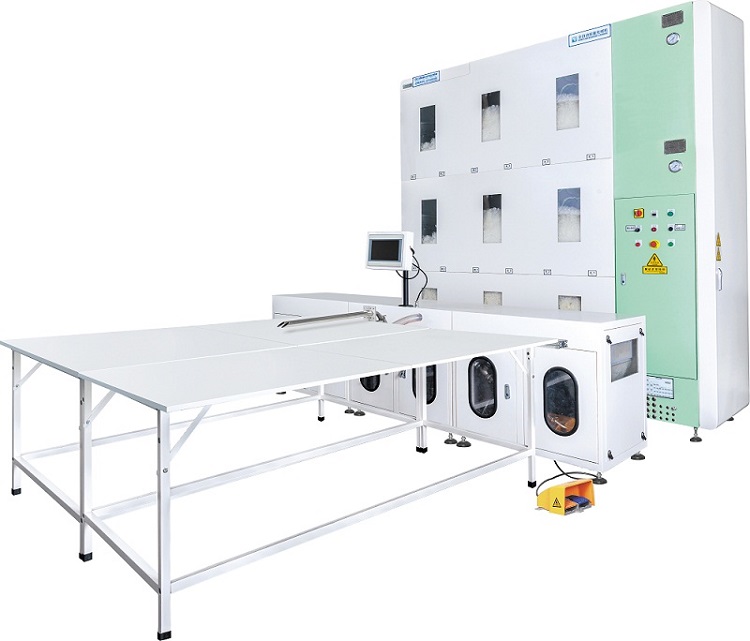
Textile Filling Machines
Source industrial Textile Filling Machines from vetted manufacturers and suppliers. Designed for importers, machinery distributors, and home textile brands looking for reliable wholesale equipment or OEM production. Find high-capacity filling systems for pillows, cushions, and apparel with verified factory-direct pricing.
Procuring industrial textile filling machines requires aligning the equipment's mechanical capabilities with your production line's exact material requirements. Whether you are outfitting a facility for high-volume polyester pillow production or precision down-jacket manufacturing, the critical variables are throughput, weighing accuracy, and pneumatic reliability. Misaligning these specs with the supplier can lead to inconsistent product weights, frequent nozzle jams, and costly downtime.
Core Specifications to Define
When negotiating with machinery manufacturers, vague requirements yield generic, often underpowered machines. You must specify the exact working parameters based on the materials being processed (e.g., conjugated hollow fiber, memory foam clusters, goose down, or blended materials).
Beyond capacity, define the electrical standards upfront. Many Chinese manufacturers build for 380V/50Hz by default. If your destination market requires 220V/60Hz or 480V/60Hz, this must be engineered into the motors and inverters from day one.
Material Compatibility and System Types
The physical properties of the filling material dictate the machine's internal architecture. Using a standard fiber blower for premium down will result in damaged clusters and wildly inaccurate fill weights.
| Machine Type | Primary Materials | Feeding Mechanism | Accuracy Level |
|---|---|---|---|
| Volumetric Fiber Blowers | Polyester fiber, pearl cotton | Continuous pneumatic blowing | Moderate (time-based) |
| Precision Weighing Fillers | Down, feathers, micro-fiber | Vacuum suction & load cells | High (gram-level) |
| Multi-Port Carousel | Blends, foam pieces | Rotary distribution | Moderate to High |
Need help verifying a manufacturer's technical capabilities before placing an equipment order?
Talk to our teamQuality Control and Factory Vetting
The apparel and textile machinery sector is crowded with assemblers who buy off-the-shelf components and weld their own frames. To ensure longevity, you must verify the origin of the critical internal components: PLCs, touch screens, load cells, and pneumatic cylinders. Reliable factories will use internationally recognized brands (e.g., Siemens, Omron, SMC, or Festo) for these parts, ensuring you can source replacements locally.
Conducting thorough factory audits is essential to distinguish genuine machinery engineers from basic assemblers. Before the equipment ships, rigorous pre-shipment quality control should include a Factory Acceptance Test (FAT) using your actual production materials.
Critical FAT Checkpoints
- Load cell calibration: Test for accuracy drift over 50 consecutive cycles.
- PLC Interface: Verify the HMI is fully translated into English (or your target language) without hardcoded Chinese errors.
- Pneumatic response: Check for lag or air leaks in the injection nozzles.
- Continuous operation: Run the machine under load for at least 2 hours to monitor motor temperatures.
Pricing, MOQs, and Lead Times
Textile filling machinery is highly modular. Because these are capital expenditures, the Minimum Order Quantity (MOQ) is universally 1 set.
- Basic Fiber Blowers: Typically range from $2,500 to $6,000 per set, depending on motor size and hopper capacity.
- Precision Down Weighing Systems: Multi-scale, fully automated down fillers run between $12,000 and $35,000+, driven by the number of weighing modules and the sensitivity of the load cells.
- Lead Times: Standard configurations usually take 15 to 25 days to manufacture. Custom voltage requirements, specialized nozzle designs, or integrated OEM branding will push lead times to 30 to 45 days.
Managing heavy machinery logistics? We handle supplier coordination, crating, and international freight.
Get a free consultationMachinery requires specialized export packaging (usually fumigated wooden crates) to prevent moisture damage and transit shock. Coordinating this with your freight forwarding provider ensures the equipment arrives ready for installation.
Frequently Asked Questions
Successfully sourcing textile filling machines comes down to precise technical communication and rigorous pre-shipment testing. By defining your material requirements, electrical standards, and component brands early in the negotiation, you protect your production line from costly inefficiencies.
Get Sourcing Help for Textile Filling Machines
Tell us your requirements and our experts will connect you with verified manufacturers.