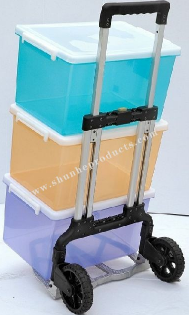
Storage Carts
Source premium Storage Carts from vetted manufacturers and wholesale suppliers across Asia. Built for importers, distributors, and retail brands requiring reliable bulk supply or OEM/private-label production, our network delivers scalable manufacturing solutions.
Sourcing storage carts at volume requires a strict balance between structural integrity and flat-pack shipping efficiency. Whether you are importing heavy-duty metal utility carts for commercial distributors or lightweight plastic organizers for the home goods market, the manufacturer's engineering capabilities directly dictate both product lifespan and your final landed cost. Success in this category hinges on specifying exact material grades, enforcing tight manufacturing tolerances, and optimizing packaging density.
Core Specifications and Material Tiers
Storage carts are primarily judged by their load-bearing capacity and mobility under weight. When negotiating with factories, vague specifications lead to component substitution. You must define the exact wall thickness of metal tubing, the specific polymer used for plastic trays, and the bearing type in the casters.
| Component | Standard / Value Tier | Premium / Heavy-Duty Tier |
|---|---|---|
| Frame Tubing | 0.6mm to 0.8mm carbon steel | 1.0mm+ carbon steel or 304 stainless |
| Trays / Baskets | Recycled PP (Polypropylene) | Virgin ABS or stamped steel mesh |
| Casters | Hard PP, friction stem, no locks | TPR or PU, dual ball bearings, locking mechanisms |
| Surface Finish | Basic spray paint or thin epoxy | Electrostatically applied powder coating (80+ microns) |
Casters are the most common point of failure. A cart rated for 20kg per tier will fail rapidly if equipped with rigid nylon casters that crack under dynamic loads. Specifying Thermoplastic Rubber (TPR) or Polyurethane (PU) casters with integrated metal threaded stems prevents stripping and ensures smooth operation.
Manufacturing Tolerances and Quality Control
The manufacturing process for metal and hybrid storage carts involves tube bending, stamping, welding, and surface treatment. Inconsistent tube bending leads to misaligned screw holes during assembly, resulting in high return rates from end-users.
Critical QC Checkpoints for Storage Carts
- Hole alignment: Verify assembly tolerances on a randomized sample before mass packing.
- Weld integrity: Inspect spot welds on wire mesh baskets for penetration and lack of sharp burrs.
- Coating adhesion: Perform a cross-cut test to ensure powder coating will not flake under impact.
- Static load testing: Apply 1.5x the rated weight capacity for 24 hours to check for frame deflection.
- Dynamic roll testing: Roll fully loaded carts across textured surfaces to verify caster stem retention.
To prevent these defects from reaching your warehouse, implementing rigorous Quality Control & Inspection during the pre-shipment phase is essential. Catching a misaligned batch at the factory allows for immediate rework; catching it after import destroys your margin.
Need to verify a supplier's production capabilities or enforce strict QC standards before placing a bulk order? Merhein can manage the vetting and inspection process on the ground.
Talk to our teamFlat-Pack Engineering and Freight Density
Storage carts are shipped knocked-down (KD). The design of the packaging is just as important as the design of the cart itself. Manufacturers must engineer the components to nest tightly, minimizing the cubic meter (CBM) volume per unit. Excess empty space in a carton means you are paying to ship air.
Optimizing carton dimensions to fit standard pallet sizes and container internal dimensions is a critical step in Shipping & Freight planning. A reduction of just 2cm in carton width can sometimes allow an extra row of product per container, significantly lowering the per-unit freight cost.
MOQ, Pricing, and OEM Customization
Most established storage cart manufacturers operate with standard Minimum Order Quantities (MOQs) tied to their raw material and finishing runs.
- Standard Off-the-Shelf: Typically 500 to 1,000 units per color.
- Custom Colors (Powder Coating): Often requires 1,000+ units to justify purging and resetting the powder coating line.
- Custom Tooling (Plastic Trays): If you are developing a proprietary tray shape or size, expect tooling costs and MOQs exceeding 3,000 units to amortize the mold expense.
When utilizing OEM/ODM Services to build a private-label line, factor in a 30 to 45-day lead time for standard production, plus an additional 15 to 25 days if custom molds or unique Pantone color matching are required.
Looking to optimize your landed costs, negotiate better MOQs, or develop a custom storage cart line? Our sourcing experts can streamline your supply chain.
Get a free consultationFrequently Asked Questions
Successfully importing storage carts at scale means looking past the initial unit price and evaluating the supplier's engineering precision, material consistency, and packaging efficiency. Partnering with a professional sourcing team ensures your specifications are met and your supply chain remains resilient.
Get Sourcing Help for Storage Carts
Tell us your requirements and our experts will connect you with verified manufacturers.