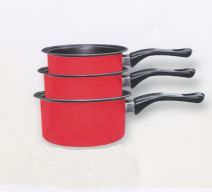
Sauce Pans
Source high-quality sauce pans in bulk directly from vetted manufacturers and suppliers. Designed for importers, wholesalers, and cookware brands seeking reliable OEM and private-label production. Ensure strict material compliance and competitive pricing for your next volume cookware order.
Sourcing sauce pans at volume requires balancing thermal performance, durability, and cost. Whether you are developing a premium fully clad stainless steel line or a high-volume non-stick aluminum range, the specifications you set dictate the factory tier you must engage. A minor oversight in base concavity or handle attachment can lead to high defect rates, compromised induction compatibility, and costly returns.
Core Specifications and Construction Methods
The performance of a sauce pan is primarily determined by its material composition and construction method. Buyers must clearly define these parameters before approaching manufacturers, as they directly impact tooling requirements and unit costs.
Material Selection and Gauge
For stainless steel sauce pans, the industry standard for the interior food-contact surface is 304 (18/8 or 18/10) grade. The exterior must be 430 grade if the pan is to be induction compatible, as 304 is non-magnetic. Material thickness (gauge) is a critical spec: premium sauce pans typically utilize a 2.5mm to 3.0mm overall thickness, while budget options may drop to 0.6mm (body) with an impact-bonded base.
For aluminum pans, specify whether the body is stamped, forged, or die-cast. Forged aluminum (typically 3.5mm to 4.0mm) offers excellent durability and heat distribution for mid-to-high-end non-stick lines, while stamped aluminum (2.0mm to 2.5mm) is reserved for entry-level retail.
| Construction Type | Heat Distribution | Tooling Cost | Target Market |
|---|---|---|---|
| Impact-Bonded Base | Focused at the base | Low | Budget to Mid-Market |
| Fully Clad (Tri-Ply) | Even across base and walls | High | Premium / Professional |
| Forged Aluminum | Excellent throughout | Medium | Mid-Market Non-Stick |
Need to match a specific gauge or material spec? Let us help you find the right manufacturer for your custom cookware line.
Talk to our teamManufacturing Tolerances and Quality Control
The manufacturing process for sauce pans involves deep drawing, washing, base bonding (or cladding), polishing, and handle assembly. Defects often occur during the bonding and assembly stages. When executing Quality Control & Inspection, your inspection teams must look beyond cosmetic blemishes.
Critical Defect Areas
- Base Concavity: A perfectly flat pan will warp when heated. The base must have a slight, controlled concavity (typically between 0.3 percent and 0.6 percent of the diameter) when cold, allowing it to expand and sit flat on induction or glass cooktops when hot.
- Handle Attachment: Handles are either riveted or spot-welded. Rivets offer visual appeal and robust mechanical strength but require careful sealing to prevent bacterial buildup. Spot welding provides a clean interior but requires precise voltage control at the factory; poor welds will fail under load testing.
- Polishing: Stainless steel pans require extensive polishing. Look for inconsistent buffing marks, pitting, or residual polishing compounds left under the rolled rim.
Essential QC Checks for Sauce Pans
- Handle torque and fatigue testing (simulating thousands of lifts)
- Thermal shock testing (heating to 200°C then plunging into cold water)
- Cross-hatch adhesion testing for non-stick coatings
- Base concavity measurement using a feeler gauge
- Boil test to check for discoloration or chemical residue
If you are developing proprietary molds or unique handle designs, leveraging specialized OEM/ODM Services ensures your intellectual property is protected and that the factory has the engineering capability to execute custom tooling accurately.
Navigating Compliance and Food Safety
Cookware is heavily regulated. Depending on your target market, your sauce pans must pass specific food contact material (FCM) regulations.
In the US, FDA compliance is mandatory, focusing on extractable lead and cadmium. For the European market, the LFGB standard is significantly stricter, testing for heavy metals and specific chemical migrations. When sourcing non-stick pans, ensure the factory uses PTFE coatings from reputable suppliers (like Whitford or Greblon) and explicitly specify PFOA-free and PFAS-compliant formulations based on current regional laws. We strongly recommend independent Compliance & Testing rather than relying solely on a factory's outdated certificates.
Pricing, MOQs, and Lead Times
Cookware manufacturing is capital intensive, relying on heavy hydraulic presses and automated polishing lines. This reality dictates minimum order quantities and pricing structures.
Pricing is highly sensitive to raw commodity indices (nickel, stainless steel, aluminum). When evaluating quotes, ensure the factory specifies the exact steel grade and weight of the pan. A common tactic to lower the price is to thin the gauge or substitute 304 stainless for 201 series on the interior, which compromises corrosion resistance.
Struggling with high MOQs or inconsistent costing? We negotiate directly with factories to secure terms that work for your production schedule.
Get a free consultationFrequently Asked Questions
Successfully sourcing sauce pans requires rigorous attention to material grades, thermal engineering, and factory capabilities. By setting strict specifications early and enforcing them through diligent on-site inspection, you can build a reliable supply chain for your cookware brand.
Get Sourcing Help for Sauce Pans
Tell us your requirements and our experts will connect you with verified manufacturers.