Quilting Machines
Source industrial Quilting Machines from vetted suppliers and manufacturers. Designed for importers, wholesalers, distributors, and brands outfitting large-scale production facilities, our network offers advanced single-needle and multi-needle quilting equipment for high-volume home textile and apparel manufacturing.
Sourcing industrial quilting machines requires balancing mechanical precision with software reliability. The primary challenge for buyers lies in identifying manufacturers whose equipment can maintain high-speed continuous operation without compromising stitch integrity, pattern accuracy, or fabric tension across varying material thicknesses.
Whether you are outfitting a facility for mattress panels, winter apparel, or heavy comforters, evaluating the core components and assembly standards of the machinery is critical to minimizing downtime on the factory floor.
Core Configurations and Technical Specifications
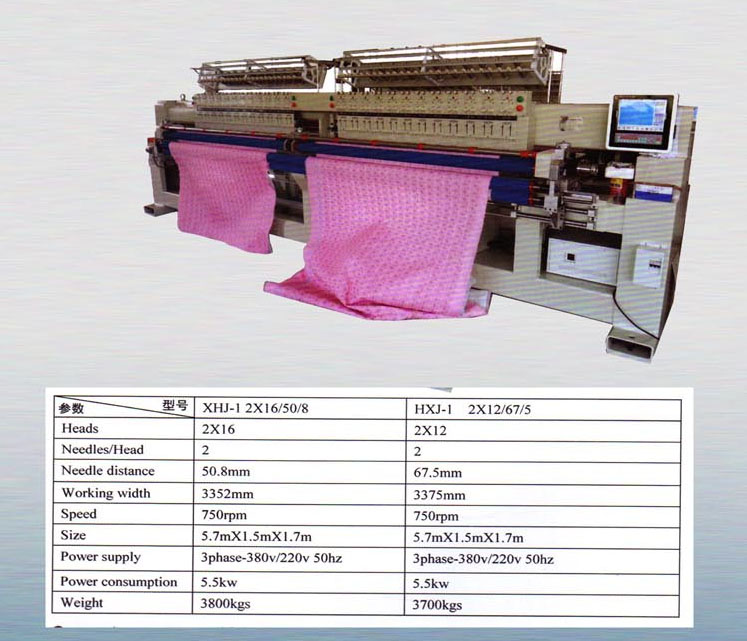
Industrial quilting machinery is broadly divided into single-needle computerized machines and multi-needle systems (chain stitch or lock stitch). The right configuration depends entirely on your production volume and pattern complexity requirements.
| Specification | Single-Needle Computerized | Multi-Needle Systems |
|---|---|---|
| Working Width | Up to 3.2m | Up to 3.3m |
| Max Speed (RPM) | 2,500 - 3,000 | 1,000 - 1,200 |
| Pattern Flexibility | High (free-motion, 360-degree) | Moderate (continuous geometric) |
| Primary Application | Custom comforters, sleeping bags | High-volume mattress panels, pads |
When specifying requirements to a manufacturer, pay close attention to the X/Y axis drive systems. The transition from traditional mechanical drives to fully servo-driven systems has drastically reduced skipped stitches and thread breakage, provided the servo motors are sourced from reputable brands.
Need help evaluating technical specifications and component origins from different manufacturers?
Talk to our teamCritical Components and Factory Floor Quality
The difference between a tier-one supplier and a lower-tier assembler often comes down to the origin of internal components and the rigidity of the machine frame. Vibrations at 3,000 RPM will quickly degrade pattern precision if the frame lacks sufficient mass or if the linear guide rails are substandard.
Key Components to Verify Before Purchase
- Servo Motors & Drives: Insist on verifiable imported brands (e.g., Panasonic, Yaskawa, or Delta) for reliable synchronization.
- Rotary Hooks: Jumbo rotary hooks (e.g., Koban or Hirose) are essential for single-needle machines to reduce bobbin change frequency.
- Linear Guide Rails: Specify THK or HIWIN guide rails for low-friction, vibration-free carriage movement.
- Needle Bar Material: Look for aviation-grade aluminum alloys for lower inertia at high speeds, or titanium alloys for heavy-duty multi-needle rigidity.
- Software Compatibility: Ensure the control system natively accepts standard DST or DSB file formats for seamless CAD integration.
Textile machinery manufacturing in China is heavily concentrated in Jiangsu (Nantong), Zhejiang, and Guangdong (Dongguan). However, not all suppliers machine their own core components. Conducting proper Factory Audits is critical to verify if a supplier has in-house CNC machining for the frame and needle bars, or if they rely entirely on outsourced parts which can lead to tolerance stacking issues.
Post-assembly, stringent Quality Control & Inspection should involve a minimum 24-hour continuous run test on the factory floor. This test must evaluate thread breakage rates, skipped stitches, and software desynchronization under load before the equipment is approved for export.
Buying Mechanics: Lead Times and Logistics
Procuring heavy industrial machinery involves unique logistical and financial considerations compared to standard consumer goods.
Shipping fully assembled quilting machines often requires complex logistics. Depending on the working width, the equipment may not fit into standard shipping containers, requiring flat-rack containers or out-of-gauge (OOG) shipping solutions. Proper Shipping & Freight coordination is necessary to ensure the machinery arrives without structural warping or exposure to moisture during transit.
Managing heavy machinery logistics, factory vetting, and supplier negotiations? Let our experts handle the heavy lifting.
Get a free consultationFrequently Asked Questions
The long-term profitability of a quilting machine is dictated by its uptime. A machine that runs seamlessly for a decade without requiring constant recalibration relies on superior servo motors, robust guide rails, and a rigid, well-machined frame. Focus on suppliers who can demonstrate rigorous in-house testing and transparent component sourcing. If you need an experienced partner on the ground to handle technical vetting, quality assurance, and complex freight logistics, our team is ready to assist.
Get Sourcing Help for Quilting Machines
Tell us your requirements and our experts will connect you with verified manufacturers.