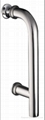
Grab Bars
Source commercial-grade grab bars from vetted suppliers and manufacturers across Asia. This catalog is built for importers, wholesalers, and brands looking for reliable bulk purchasing, OEM/ODM production, and private-label manufacturing. Secure compliant, high-capacity supply for construction and healthcare projects.
Sourcing grab bars in volume requires balancing strict safety compliance with competitive unit costs. Because these fixtures are critical safety devices, a failed weld, inferior steel grade, or inadequate mounting flange doesn't just result in a product return—it creates severe liability. Securing a reliable supply chain means vetting factories for their metalworking precision, finishing quality, and adherence to international accessibility standards.
Critical Specifications & Material Selection
The foundational cost and performance driver for any grab bar is the base material. While brass and aluminum are used in niche decorative applications, stainless steel dominates commercial and healthcare markets. However, not all stainless steel is suitable for high-moisture environments.
| Material Grade | Corrosion Resistance | Typical Application | Cost Profile |
|---|---|---|---|
| 304 Stainless Steel | Excellent | Hospitals, Commercial, ADA Compliance | Premium |
| 201 Stainless Steel | Low to Moderate | Residential, Low-Moisture Areas | Economy |
| Nylon-Coated (Over Steel/Alu) | High | Elderly Care, Anti-Slip Requirements | Mid-to-High |
Dimensional Standards and Tubing
For commercial applications, dimensional accuracy is non-negotiable. Accessibility standards (such as ADA in the US) typically mandate an outer diameter of 1.25 inches to 1.5 inches.
Equally important is the tubing wall thickness. Economy bars often use 0.8mm walls, which can flex under heavy loads. Commercial-grade bars should specify a wall thickness of 1.0mm to 1.2mm to comfortably support the standard 250 lbs to 500 lbs load requirements.
Need to source ADA-compliant grab bars with strict material tolerances? We can match your specifications with vetted manufacturers capable of consistent, high-yield production.
Talk to our teamManufacturing Tolerances & Quality Control
The structural integrity of a grab bar is won or lost at the flange weld. Factories producing high-quality bars use automated TIG welding to join the tubing to the mounting flange, ensuring a continuous, void-free bond.
When evaluating a factory's output, pay close attention to the finishing process. For polished or brushed finishes, inconsistent grain or pitting indicates poor polishing wheel maintenance. For colored finishes (matte black, brushed gold), PVD (Physical Vapor Deposition) offers superior durability over standard powder coating, resisting the harsh cleaning chemicals used in healthcare environments.
Pre-Shipment Inspection Checklist for Grab Bars
- Verify tubing wall thickness using digital calipers (min 1.0mm for commercial).
- Inspect flange welds for continuous beads and lack of porosity.
- Perform salt spray testing (typically 48 to 96 hours) to verify 304 SS grade and finish durability.
- Conduct static load testing to ensure the bar and flange do not deform under specified weight ratings.
- Check concealed flange covers for proper fit and smooth threading/snapping action.
Executing rigorous Quality Control & Inspection prior to shipment is vital to catch plating defects or dimensional variations before they enter your supply chain. Furthermore, comprehensive Compliance & Testing ensures your products meet the necessary load-bearing and accessibility certifications for your target market.
Production Realities: MOQs, Pricing, and Lead Times
Manufacturers typically structure their pricing based on material grade, finish, and order volume. Tooling for custom lengths or unique flange designs will incur upfront costs, but standard configurations are readily available.
If you are developing a proprietary design or requiring specific retail packaging, engaging a factory with proven OEM/ODM Services is highly recommended. They will have the engineering support to manage custom tooling and ensure the final product scales efficiently.
Looking to consolidate your bathroom hardware supply chain? Let us negotiate pricing, manage MOQs, and oversee quality control directly on the factory floor.
Get a free consultationFrequently Asked Questions
Securing Your Supply Chain
Procuring grab bars in bulk is an exercise in risk management. A supplier might provide a flawless 304 stainless steel sample, only to substitute 201 stainless steel in the final production run to pad their margins. Mitigating this risk requires consistent oversight and professional Factory Audits before POs are signed. By working with experienced sourcing partners, you ensure that every container arrives exactly to spec, fully compliant, and ready for installation.
Get Sourcing Help for Grab Bars
Tell us your requirements and our experts will connect you with verified manufacturers.