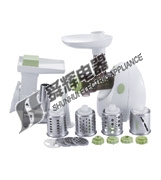
Fruit & Vegetable Tools
Source premium wholesale fruit and vegetable tools directly from vetted manufacturers and factories in Asia. Designed for importers, distributors, and kitchenware brands seeking high-volume OEM, ODM, or private-label production with strict quality control.
Sourcing fruit and vegetable tools at scale requires navigating a highly fragmented supplier base while balancing aggressive cost targets against strict food-contact safety regulations. The primary failure points in this category rarely stem from the fundamental design; they arise from compromised material selection, poor blade heat treatment, and inadequate assembly tolerances that lead to water ingress or structural failure during heavy use.
To build a reliable supply chain for kitchen tools, buyers must specify exact metallurgical grades for cutting components, mandate food-safe polymers for handles, and enforce rigorous in-line inspections.
Material Specifications: The Core of Kitchen Tool Sourcing
The distinction between a premium tool and a high-return-rate liability lies almost entirely in the bill of materials (BOM). Manufacturers often attempt to substitute cheaper stainless steel grades or non-compliant plastics to improve their margins.
Blade Metallurgy and Steel Selection
Not all stainless steel is suitable for cutting. A common mistake is accepting "304 stainless" for blades; while 304 offers excellent corrosion resistance, it is too soft to hold an edge.
| Component | Recommended Material | Key Properties & Sourcing Notes |
|---|---|---|
| Cutting Blades | 420J2 / 440A Stainless | High carbon content for hardness (HRC 50-54). Excellent edge retention. Requires precise heat treatment and mirror polishing to prevent rust. |
| Structural Wire / Mesh | 304 Stainless Steel | Superior rust resistance for parts constantly exposed to acidic fruit juices. Cannot be hardened for sharp edges. |
| Tool Bodies & Housings | Food-Grade ABS or PC | High impact resistance, rigid, and easily color-matched (Pantone). Must specify BPA-free and FDA/LFGB compliance. |
| Ergonomic Grips | TPR / TPE Overmolding | Provides non-slip texture even when wet. Requires dual-injection molding capabilities at the factory level. |
Need to verify a factory's material claims? We conduct on-site supplier vetting and manage the entire sourcing process to ensure your specifications are strictly met.
Talk to our teamManufacturing Processes and Factory Capabilities
When evaluating a manufacturer, their tooling and assembly capabilities dictate the final product's durability. Many fruit and vegetable tools require a combination of metal stamping, plastic injection molding, and complex assembly (such as insert molding or ultrasonic welding).
Relying on a factory that outsources its metal stamping while only handling plastic injection in-house can lead to severe tolerance mismatches. Blades that wobble or handles that trap food particles are direct results of poor dimensional control between disparate manufacturing lines. Conducting thorough Factory Audits is critical to verify that the supplier has the necessary in-house equipment or tightly controlled sub-contractors.
Critical Quality Control Checkpoints
To prevent defective units from shipping, your Quality Control & Inspection protocols must go beyond basic visual checks. Incorporate these specific tests into your AQL (Acceptable Quality Limit) requirements:
Essential QC Checks for Fruit & Vegetable Tools
- Salt Spray Testing: Minimum 24-hour salt spray test on all metallic components to verify corrosion resistance.
- Hardness Testing (HRC): Verify blade hardness meets specified parameters (typically HRC 50-54 for 420J2 steel).
- Pull/Tension Testing: Ensure blades and handles withstand a minimum of 15kg of pull force without separating.
- Dishwasher Simulation: Test for warping, color fading, or water ingress in ultrasonic-welded seams.
- Sharpness & Functionality: Standardized cutting tests on actual produce (e.g., carrots, tomatoes) to ensure consistent blade grinding angles.
Production Economics: MOQs, Pricing, and Lead Times
Understanding the realistic production economics of kitchen gadgets helps in negotiating with factories and planning your inventory. Pricing is highly sensitive to the chosen materials, the complexity of the molds, and the specific food-contact certifications required for your target market.
If you are developing custom tools, OEM/ODM Services will require upfront investment in injection molds and metal stamping dies.
Navigating tooling costs and MOQs can be complex. Let our sourcing experts negotiate the best terms and manage your production schedule directly with the factory.
Get a free consultationRegulatory Compliance and Food Safety
Fruit and vegetable tools are classified as Food Contact Materials (FCM). Importing non-compliant products can result in customs seizures or costly recalls. The regulatory standard depends entirely on your target market:
- United States (FDA): Requires extraction testing to ensure plastics and metals do not leach harmful substances into food.
- European Union (LFGB / REACH): LFGB (Germany/EU) is significantly stricter than the FDA, requiring intensive testing for heavy metals and chemical migration. Products passing LFGB are generally accepted globally.
Always specify the required standard in your purchase order and ensure independent Compliance & Testing is conducted at a certified third-party lab (like SGS or TUV) before shipment. Never rely solely on a factory's past test reports, as materials can change between production runs.
Successfully importing fruit and vegetable tools requires a deep understanding of material science, factory capabilities, and food-contact regulations. By specifying exact materials and enforcing strict QC protocols, buyers can eliminate the most common defects and build a highly profitable, scalable product line.
Get Sourcing Help for Fruit & Vegetable Tools
Tell us your requirements and our experts will connect you with verified manufacturers.