Escalators
Source commercial and heavy-duty escalators directly from vetted suppliers and manufacturers. Designed for construction procurement managers, large-scale distributors, and importers, our network provides reliable, high-volume production for infrastructure, retail, and commercial real estate projects worldwide.
Sourcing escalators requires navigating complex safety regulations, heavy-duty engineering specifications, and highly specialized logistics. For commercial developers, equipment distributors, and infrastructure contractors, selecting the right manufacturing partner dictates not just the unit's operational lifespan, but the fundamental safety and compliance of the final installation. Success in this category depends on strict oversight of the supply chain, from raw steel procurement to final load testing.
Key Specifications for Procurement
When ordering escalators for commercial or public transit projects, the specifications must align perfectly with the architectural constraints and local safety codes. Factories base their engineering drawings and pricing models on these core parameters.
| Parameter | Standard Commercial (Retail) | Heavy-Duty (Public Transit) |
|---|---|---|
| Typical Inclination | 30 or 35 degrees | Strictly 30 degrees |
| Step Width | 600mm, 800mm, 1000mm | 1000mm standard |
| Rated Speed | 0.5 m/s | 0.5 m/s or 0.65 m/s |
| Operating Hours | 12-14 hours/day | 20-24 hours/day |
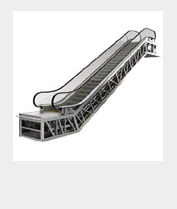
The structural integrity of the escalator relies heavily on the truss design. Deflection limits under maximum load must be strictly calculated, typically requiring a deflection ratio of under 1/750 for standard units and under 1/1000 for transit applications.
Manufacturing Variances and Component Sourcing
The reliability of an escalator is won or lost in the quality of its internal components. While many factories assemble the final product, they source motors, controllers, and step chains from sub-suppliers. Understanding this tier-two supply chain is critical.
Conducting thorough factory audits helps verify whether a manufacturer machines their own drive units or relies on third-party components, which directly impacts long-term parts availability and warranty support.
Need help verifying the engineering capabilities of an escalator manufacturer?
Talk to our teamCritical Components to Evaluate
- Step Chains: The breaking load of the step chain is a primary safety factor. High-traffic environments require roller chains with a breaking load significantly higher than standard retail models, often utilizing specialized lubrication-free or automatic lubrication systems.
- Drive Systems: Evaluate the efficiency and thermal rating of the main drive gearbox. Worm gear systems are common, but helical gear systems offer higher efficiency for heavy-duty applications.
- Truss Welding: The main structural truss must be welded using automated or highly controlled manual processes. Poor weld penetration leads to structural fatigue over time.
Quality Control and Safety Compliance
Escalators are heavily regulated. Depending on your target market, units must comply with strict international standards such as EN 115-1 (Europe) or ASME A17.1 / CSA B44 (North America). Securing reliable compliance and testing documentation before production begins is non-negotiable.
Pre-Shipment Inspection Focus Areas
- Verification of step-to-skirt clearance tolerances to prevent entrapment.
- Functional testing of all safety switches (comb plate, step chain, handrail entry).
- Measurement of braking distance under simulated load conditions.
- Inspection of truss galvanization thickness (critical for outdoor or semi-outdoor units).
- Verification of controller software logic and variable frequency drive (VFD) parameters.
Implementing rigorous quality control and inspection protocols at the factory ensures these safety mechanisms are physically tested before the equipment is containerized.
Pricing Drivers, MOQs, and Logistics
The baseline cost of an escalator is driven by the rise height, step width, and the specific application (indoor vs. outdoor). Upgrading to a fully outdoor unit requires IP55-rated electrical components, stainless steel chains, structural galvanization, and built-in oil/water separators, which can increase the unit cost by 30 percent or more.
While the Minimum Order Quantity (MOQ) for escalators is typically 1 unit due to their project-specific nature, bulk pricing tiers usually begin at 3 to 5 units.
Freight Considerations
Escalators are massive, awkwardly shaped cargo. Units with a rise height under 4.5 meters can often ship fully assembled in 40ft High Cube or Open Top containers. Taller units must be manufactured in modular sections and spliced on-site.
Coordinating the movement of heavy machinery requires specialized shipping and freight handling, including flat rack containers, specialized rigging, and precise delivery scheduling to match construction timelines.
Optimize your heavy equipment supply chain and reduce freight risks.
Get a free consultationFrequently Asked Questions
Sourcing escalators successfully requires looking past the initial unit price and focusing on total cost of ownership—which includes manufacturing precision, compliance reliability, and freight efficiency. Aligning with manufacturers who maintain strict engineering tolerances ensures your projects are delivered safely, on time, and up to code.
Get Sourcing Help for Escalators
Tell us your requirements and our experts will connect you with verified manufacturers.