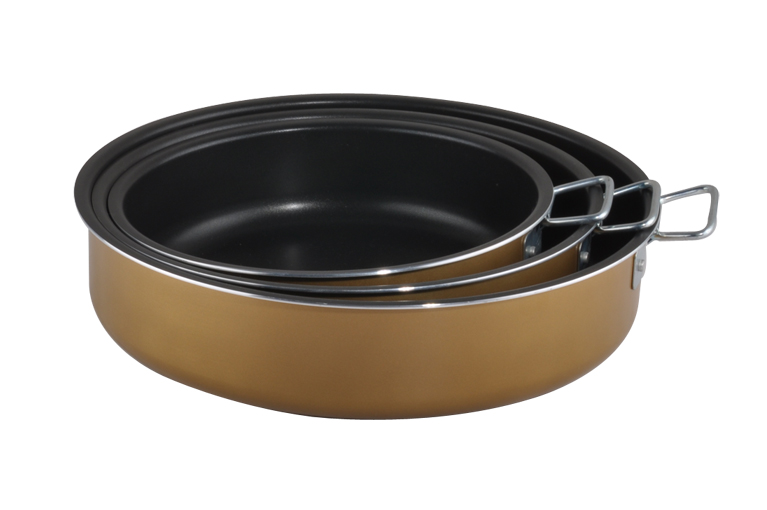
Cookware Sets
Source high-quality Cookware Sets from vetted suppliers and manufacturers across Asia. Designed for importers, distributors, and brands seeking reliable OEM/ODM production, our wholesale catalog offers scalable manufacturing solutions tailored to your specific material, performance, and volume requirements.
Sourcing cookware sets in volume requires balancing raw material costs, thermal performance, and aesthetic appeal while maintaining strict regulatory compliance. The core procurement challenge lies in specifying the exact material grades, ply constructions, and coating thicknesses that align with your target market's price point and durability expectations, ensuring consistency across every piece in a multi-item set.
Core Specifications and Material Architecture
The foundation of any cookware set dictates its manufacturing process, tooling costs, and final market positioning. Professional buyers must strictly define the gauge (thickness) and composition of the base materials.
- Stainless Steel: Typically utilizes 304-grade (18/8 or 18/10) for the food-contact interior due to its high corrosion resistance, and 430-grade for the exterior to ensure induction compatibility. Construction is usually either an impact-bonded encapsulated base (an aluminum disc fused to the bottom) or fully clad tri-ply (Stainless-Aluminum-Stainless throughout the vessel).
- Aluminum: Dominates the non-stick market. Stamped aluminum (typically 2.0mm to 3.0mm) is cost-effective but prone to warping. Forged aluminum (3.0mm to 4.5mm) offers a thicker base for better heat distribution and warp resistance. Die-cast aluminum allows for complex shapes and varying thicknesses but requires higher initial tooling investments.
| Material Construction | Typical Gauge | Best Application | Primary Sourcing Risk |
|---|---|---|---|
| Tri-Ply Stainless Steel | 2.0mm - 2.5mm | Premium retail & professional | Delamination if poorly bonded |
| Forged Aluminum | 3.0mm - 4.5mm | Mid-to-high non-stick | Base concavity tolerances |
| Stamped Aluminum | 2.0mm - 3.0mm | Entry-level & promotional | Warping under high heat |
Manufacturing Controls and Quality Assurance
Quality is won or lost in the factory's finishing and assembly stages. Coating application and handle attachment are the two most critical failure points in cookware manufacturing.
When evaluating potential partners, conducting thorough Factory Audits is essential to verify their automated coating lines and curing ovens. Hand-sprayed coatings often suffer from inconsistent thickness, leading to premature peeling. Furthermore, handle attachment—whether riveted (highly durable but harder to clean) or spot-welded (clean interior but requires precise voltage control)—demands rigorous mechanical testing.
Avoid costly returns by standardizing your inspection protocols and defect tolerances early in the sourcing process.
Discuss your QC requirementsImplementing robust Quality Control & Inspection protocols at the factory level prevents defective sets from being packaged and shipped.
Critical Pre-Shipment QC Checks for Cookware
- Base Concavity Tolerance: Ensure bases are slightly concave when cold to expand flat when heated.
- Cross-Hatch Adhesion Test: Verify non-stick coating bonding to the substrate.
- Handle Torque and Fatigue Testing: Confirm handles withstand repeated lifting under load without loosening.
- Thermal Shock Resistance: Plunge heated vessels into cold water to test for warping or delamination.
- Lid Fit and Steam Venting: Check tempered glass lids for precise seating and proper steam release.
Customization, OEM/ODM, and Compliance
For brands looking to differentiate, custom tooling for unique vessel profiles, proprietary handle molds, and bespoke exterior heat-resistant paint (HRP) colors are standard requirements. Leveraging specialized OEM/ODM Services allows you to develop proprietary sets without managing the factory floor directly.
However, any customization must be paired with stringent regulatory verification. Cookware sets must pass specific food-contact material (FCM) regulations for your target market, such as US FDA standards or the stricter European LFGB requirements, which mandate rigorous heavy metal extraction tests. Partnering with experts for Compliance & Testing ensures your custom coatings and alloys meet all legal thresholds before mass production begins.
Production Realities: MOQs, Lead Times, and Pricing
Cookware sets are capital-intensive to produce, and pricing is heavily indexed to global aluminum and steel commodities. Because a single set involves multiple vessel sizes, lids, and accessories, factories must coordinate several production lines simultaneously.
Navigate fluctuating raw material costs and secure stable, competitive pricing for your next volume cookware order.
Get a sourcing assessmentSuccessful cookware sourcing relies on locking down precise material specifications and enforcing strict mechanical tolerances on the factory floor. By standardizing your technical requirements and maintaining rigorous oversight during production, you can scale your inventory reliably while minimizing defect rates.
Get Sourcing Help for Cookware Sets
Tell us your requirements and our experts will connect you with verified manufacturers.