Busbar Machines
Source industrial-grade busbar machines from vetted suppliers and manufacturers. Designed for electrical equipment manufacturers, wholesalers, and specialized distributors, our catalog connects you directly with factories offering robust OEM and ODM production for high-volume import.
Sourcing busbar processing machines requires balancing heavy-duty mechanical reliability with precise control systems. For electrical panel builders, switchgear manufacturers, and industrial distributors, the core challenge is finding manufacturing partners who deliver consistent hydraulic performance and durable tooling without the excessive markups of established legacy brands.
Evaluating these machines goes far beyond looking at the spec sheet; it requires scrutinizing the factory’s hydraulic integration, controller sourcing, and structural engineering.
Defining Core Machine Specifications
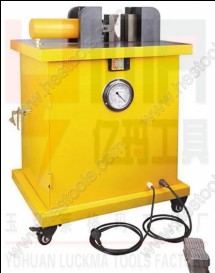
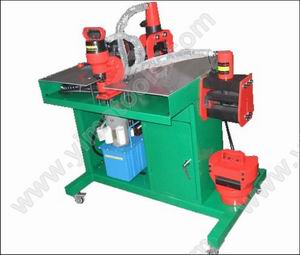
When communicating with manufacturers, precision in your technical requirements dictates the tier of machine you will receive. The standard 3-in-1 busbar machine (cutting, punching, bending) must be specified across several critical parameters:
- Processing Capacity: Factories classify machines by maximum busbar width and thickness (e.g., 160mm x 12mm or 250mm x 15mm). Specifying copper versus aluminum is also necessary, as the shear strength requirements differ slightly.
- Hydraulic Tonnage: Typical machines range from 30T to 50T per station. Insufficient tonnage leads to burrs during punching and uneven cuts during shearing.
- Control Architecture: Specify whether you require a PLC-based semi-automatic system or a full CNC system with servo-driven positioning.
Need help vetting industrial machinery manufacturers and verifying their technical capabilities?
Talk to our teamManufacturing Tolerances and Quality Control
The visual appearance of a busbar machine rarely indicates its operational longevity. Quality is won or lost in the internal components and the factory's machining tolerances. When evaluating a supplier or conducting factory audits, focus on the following areas:
Hydraulic Systems and Seals
The most common failure point in imported busbar machinery is hydraulic leakage or pressure drop. High-quality manufacturers will utilize imported seals (often NOK from Japan) and reputable hydraulic valves (like Rexroth or Yuken). Domestic Chinese valves are acceptable for budget tiers, but they must be explicitly specified during the negotiation phase.
Tooling and Die Metallurgy
Punching dies and shearing blades must be forged from high-grade alloy steel, typically Cr12MoV, and subjected to proper vacuum heat treatment. Improperly hardened dies will chip or dull rapidly, leading to unacceptable burrs on the copper busbar, which can cause electrical arcing in the final switchgear assembly.
Structural Rigidity
The machine frame must be welded from heavy-gauge steel and, crucially, stress-relieved (via vibration or thermal annealing) before final machining. If the frame is not stress-relieved, the hydraulic forces will eventually warp the chassis, destroying the alignment of the punching and shearing stations.
Critical Pre-Shipment Inspection Points
- Verify hydraulic system pressure stability under maximum load for 30 minutes.
- Inspect sheared copper samples for burrs, indicating improper blade clearance or dull tooling.
- Test CNC bending angle accuracy against the programmed input (tolerance should be within ±0.3 degrees).
- Confirm all safety interlocks, light curtains, and emergency stops function instantly.
- Check controller language settings and metric/imperial unit conversions.
Implementing rigorous quality control & inspection prior to container loading is essential, as returning heavy machinery is economically unviable.
Sourcing Mechanics: MOQs, Lead Times, and Pricing
Because busbar machines are high-value capital equipment, Minimum Order Quantities (MOQs) are highly flexible.
- MOQs: Standard MOQ is typically 1 set. For distributors looking to private-label or request custom paint and branding, factories may request an MOQ of 3 to 5 sets.
- Lead Times: Standard configurations usually require 15 to 25 days for assembly and testing. Fully customized CNC machines or those requiring non-standard voltage configurations (e.g., 480V 60Hz for North America) can extend lead times to 35 to 45 days.
- Pricing Drivers: A basic manual/semi-auto 3-in-1 machine can range from $3,000 to $5,000. Upgrading to a full CNC system with Siemens or Mitsubishi controllers, servo-driven positioning, and multi-pump hydraulic systems pushes the typical price range to $10,000 to $18,000 or more.
| Feature | Semi-Auto (PLC) | Full CNC |
|---|---|---|
| Bending Precision | Relies on limit switches | Servo-driven closed-loop |
| Production Speed | Moderate | High-volume repetitive |
| Operator Skill Req. | Higher manual input | Lower (program driven) |
| Cost Tier | Entry to Mid-level | Premium |
Given the weight and dimensions of these machines, proper crating and logistics planning are vital. Machines must be secured in moisture-barrier packaging and properly lashed inside the container. Coordinating shipping & freight with a partner experienced in heavy machinery prevents transit damage and unexpected port fees.
Looking to optimize your machinery supply chain and reduce international freight risks?
Get a free consultationFrequently Asked Questions
Successfully sourcing busbar machinery is about looking past the external paint and focusing on the integrity of the hydraulics, metallurgy, and control systems. By clearly defining your technical requirements and enforcing strict pre-shipment validation, you can secure industrial-grade equipment that delivers decades of reliable service.
Get Sourcing Help for Busbar Machines
Tell us your requirements and our experts will connect you with verified manufacturers.