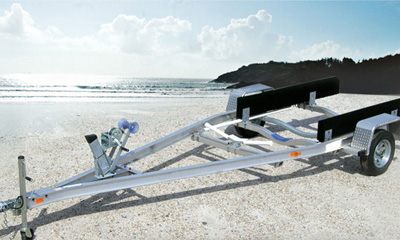
Boat & Watercraft Trailers
Source bulk Boat & Watercraft Trailers from vetted suppliers and manufacturers. Designed for importers, wholesalers, distributors, and brands looking for reliable OEM/private-label production, our network delivers durable, compliant marine transport solutions at scale.
Sourcing marine trailers requires balancing heavy-duty structural integrity with severe anti-corrosion requirements. Because these vehicles are repeatedly submerged in fresh or saltwater, standard utility trailer manufacturing processes are insufficient. For volume buyers, the primary challenge lies in identifying factories capable of consistent hot-dip galvanizing, marine-grade electrical sealing, and strict adherence to regional road safety compliance.
Core Specifications and Materials
The chassis material and axle configuration dictate both the trailer's lifespan and its target market. Factories typically specialize in either steel or aluminum fabrication, and tooling for one does not seamlessly translate to the other.
| Specification | Hot-Dip Galvanized Steel | Aluminum Alloy (I-Beam) |
|---|---|---|
| Durability & Flex | High rigidity, handles heavy loads well | More flex, excellent for lighter craft |
| Corrosion Resistance | Strong, provided galvanizing is thick (80+ microns) | Superior natural resistance to saltwater |
| Weight | Heavy (increases towing vehicle requirements) | Lightweight (improves fuel efficiency) |
| Cost Profile | Lower raw material cost, higher processing cost | Higher raw material cost, lower processing cost |
Axle and Suspension Selection
The choice between leaf spring and torsion axles impacts ride quality and maintenance. Torsion axles offer an independent suspension system and a lower ride height, which makes launching and loading boats easier. However, they are more expensive and harder to repair if damaged. Leaf springs are cost-effective and easy to replace, but require constant maintenance to prevent saltwater corrosion. When specifying axles, ensure the factory uses marine-grade grease seals and stainless steel bearing protectors.
Navigating regional axle and braking requirements can delay production. Let us help you align your specifications with local compliance laws.
Talk to our teamQuality Control and Compliance Standards
A trailer is a road-going vehicle, meaning it must pass strict regional transport regulations before it can be legally sold. Importing non-compliant trailers results in customs seizures or unsellable inventory.
- North America (DOT/NHTSA): Requires specific lighting configurations, VIN formatting, and weight-rated tires.
- Europe (O1/O2 Categories & E-Mark): Requires E-mark certified lights, reflectors, and specific overrun braking systems for trailers over 750kg.
- Australia (ADR): Mandates specific safety chain ratings, braking systems based on ATM (Aggregate Trailer Mass), and lighting compliance.
Catching defects before shipment is critical. A robust Quality Control & Inspection protocol should focus on the integrity of the hot-dip galvanizing (checking for zinc pooling or bare spots), the sealing of the wiring harness (which must be fully enclosed and waterproof), and the penetration of structural welds. If you are importing into highly regulated markets, coordinating proper Compliance & Testing for components like couplers and safety chains is non-negotiable.
Factory Vetting for Marine Trailers
Not all trailer factories are equipped for marine environments. Many standard utility trailer manufacturers will attempt to produce boat trailers by simply painting or cold-galvanizing standard steel frames—a recipe for rapid failure in saltwater.
Critical Factory Vetting Criteria
- In-house or tightly controlled third-party hot-dip galvanizing facilities.
- Experience with waterproof, heat-shrink electrical connections.
- ISO 9001 certification with documented weld-testing procedures.
- Familiarity with producing to DOT, E-Mark, or ADR standards.
- Capacity to manufacture and pack in SKD/CKD formats to optimize freight.
Conducting thorough Factory Audits ensures your chosen supplier actually possesses the specialized tooling and quality management systems required for marine-grade production.
Pricing, MOQs, and Logistics Reality
Shipping fully assembled (CBU) boat trailers internationally is economically unviable due to the massive amount of wasted space inside a shipping container. Almost all bulk orders are shipped as SKD (Semi-Knocked Down) or CKD (Completely Knocked Down).
Designing the trailer for efficient container packing is a crucial step. Factories experienced in export will design bolt-together frames or modular drawbars that allow them to stack dozens of trailers into a single 40ft High Cube container. Managing this complex packing and the subsequent international transit requires experienced Shipping & Freight coordination to keep landed costs competitive.
Optimize your container loads and reduce freight costs. We can help you negotiate CKD packing configurations with the factory.
Get a free consultationFrequently Asked Questions
Successful sourcing of boat and watercraft trailers requires deep attention to anti-corrosion treatments, road-safety compliance, and freight-optimized packaging. By carefully vetting suppliers and structuring your orders for CKD shipping, you can secure high-quality marine transport solutions that protect both the watercraft and your bottom line.
Get Sourcing Help for Boat & Watercraft Trailers
Tell us your requirements and our experts will connect you with verified manufacturers.