Bevel Gears
Source precision-engineered bevel gears from vetted manufacturers and suppliers. Designed for importers, industrial distributors, and brands requiring OEM production, our network delivers reliable, high-volume gear solutions. Secure competitive wholesale pricing and consistent quality for your machinery applications.
Bevel gears are critical components for transmitting mechanical power and altering the direction of shaft rotation, typically at a 90-degree angle. When sourcing these components in volume, the primary challenge is not simply finding a machining facility, but identifying a manufacturer capable of balancing metallurgical integrity with strict dimensional tolerances. A minor deviation in tooth profile or heat treatment can lead to excessive noise, accelerated wear, and catastrophic failure in high-load applications.
Defining Your Gear Specifications
To secure accurate quotes and ensure reliable performance, technical specifications must be explicitly defined for the factory. Chinese manufacturers typically default to the metric module (m) system and DIN standards, so if your designs use Diametral Pitch (DP) or AGMA grades, clear conversion and communication are essential.
Key parameters to define in your technical drawing package include:
- Module (m) or Diametral Pitch (DP): Dictates the size of the gear teeth.
- Pressure Angle & Shaft Angle: Typically 20 degrees for pressure angle and 90 degrees for shaft angle, though custom configurations require specialized tooling.
- Material Selection: 20CrMnTi is the standard Chinese alloy steel for carburized gears (roughly equivalent to AISI 8620), offering excellent core toughness and surface hardness. For heavy-duty applications, 42CrMo (similar to AISI 4140) is frequently specified.
- Heat Treatment: Specify the required case depth and surface hardness (usually HRC 58-62 for carburized and quenched gears), alongside core hardness requirements.
| Gear Type | Performance Characteristics | Typical Manufacturing Process |
|---|---|---|
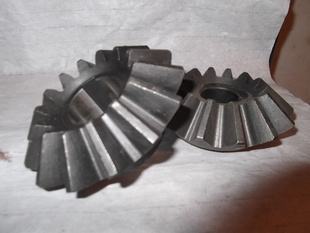
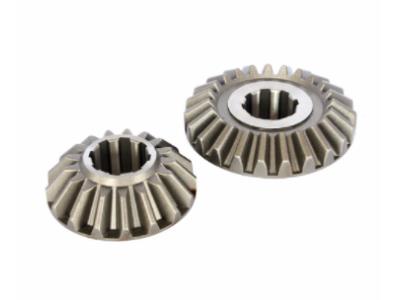
| Straight Bevel | Cost-effective, higher noise at speed, moderate load capacity | Gear milling or planing, often unground |
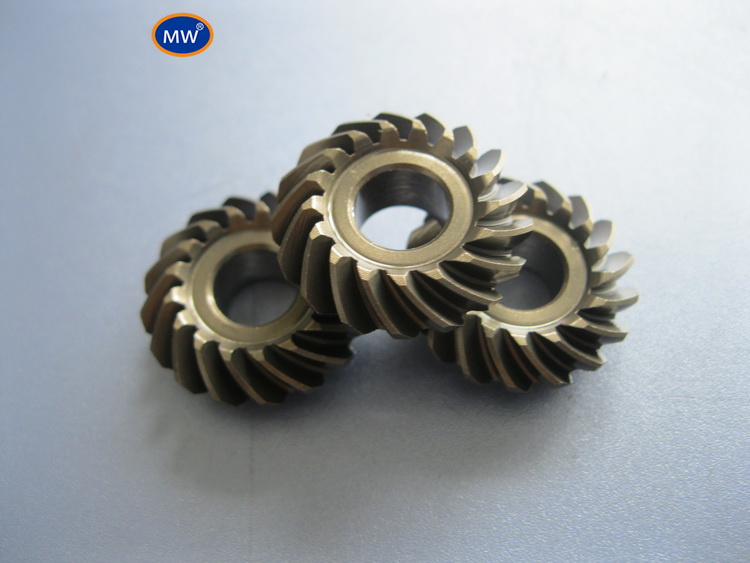
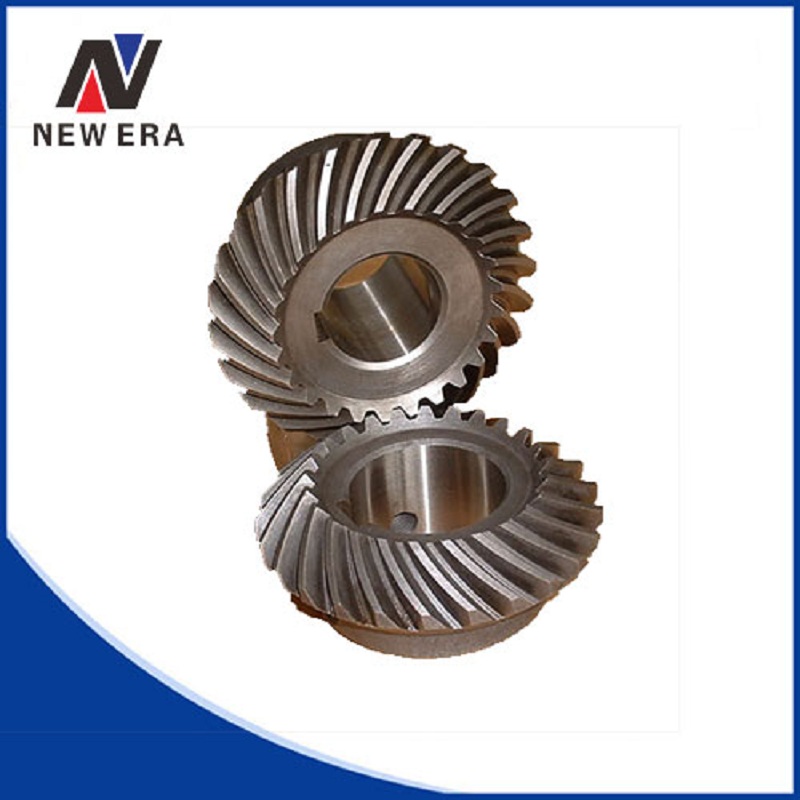
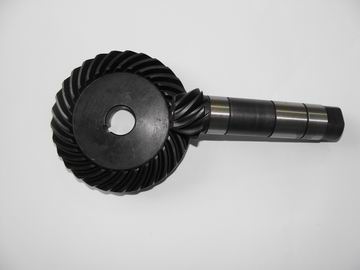
| Spiral Bevel | Smooth engagement, lower noise, high torque capacity | Gleason or Klingelnberg CNC cutting, lapping or grinding |
Match your custom gear specifications with a manufacturer verified for high-precision CNC machining and heat treatment.
Talk to our teamManufacturing Tolerances and Quality Control
The gap between a functional prototype and a reliable bulk production run is bridged by rigorous quality control. The critical failure point for most imported bevel gears is heat treatment distortion. If a factory lacks advanced quenching presses or post-heat-treat grinding capabilities (such as hard skiving or CNC gear grinding), the gears will not meet high DIN or AGMA precision grades.
When evaluating a supplier's capabilities, or when utilizing professional Quality Control & Inspection services, focus on the following verification points:
Critical Gear Inspection Points
- Material chemistry verification via spectrometer prior to forging.
- Effective Case Depth (ECD) and micro-hardness testing on sectioned samples.
- Tooth profile, pitch deviation, and runout inspection using a Coordinate Measuring Machine (CMM) or dedicated gear tester.
- Contact pattern testing (rolling test) to ensure proper meshing and verify backlash limits.
Relying solely on a factory's self-reported inspection data carries risk. Conducting comprehensive Factory Audits before placing high-volume orders ensures the facility actually possesses the Gleason or Klingelnberg machinery they claim, rather than outsourcing the most critical finishing steps to unverified third-party workshops.
Pricing, MOQs, and Lead Times
Bevel gear pricing is heavily dependent on the material grade, the complexity of the tooth profile (spiral vs. straight), and the required precision class. Standard, catalog-dimension straight bevel gears are highly commoditized, while custom spiral bevels require significant engineering setup.
For brands developing proprietary machinery, leveraging OEM/ODM Services allows for exact replication of custom tooth geometries. Keep in mind that initial runs will require a longer lead time (often 60 days or more) to account for tooling creation, first-article inspection (FAI), and necessary adjustments to the contact pattern.
Successfully sourcing bevel gears requires looking past the initial unit price to understand the factory's underlying metallurgical and metrology capabilities. Securing the right manufacturing partner ensures your production lines keep moving and your end products perform reliably in the field.
Get Sourcing Help for Bevel Gears
Tell us your requirements and our experts will connect you with verified manufacturers.