Air Condensers
Source premium automotive air condensers from vetted manufacturers and wholesale suppliers across Asia. Designed for auto parts distributors, importers, and brands seeking reliable OEM production, our catalog connects you with high-volume factories capable of meeting strict thermal performance and durability standards.
Procuring automotive air condensers at scale requires navigating a complex matrix of thermal efficiency requirements, material durability, and precision manufacturing. As vehicle cooling systems become more compact and operate under higher pressures, the margin for error in condenser manufacturing has shrunk. A poorly brazed core or inadequate corrosion resistance doesn't just result in a failed part—it compromises the entire A/C compressor and system.
Engineering and Specifying Automotive Air Condensers
Modern automotive condensers are overwhelmingly aluminum due to its optimal balance of weight, cost, and thermal conductivity. However, the internal architecture and the specific alloys used dictate the component's performance and lifespan.
Core Architecture
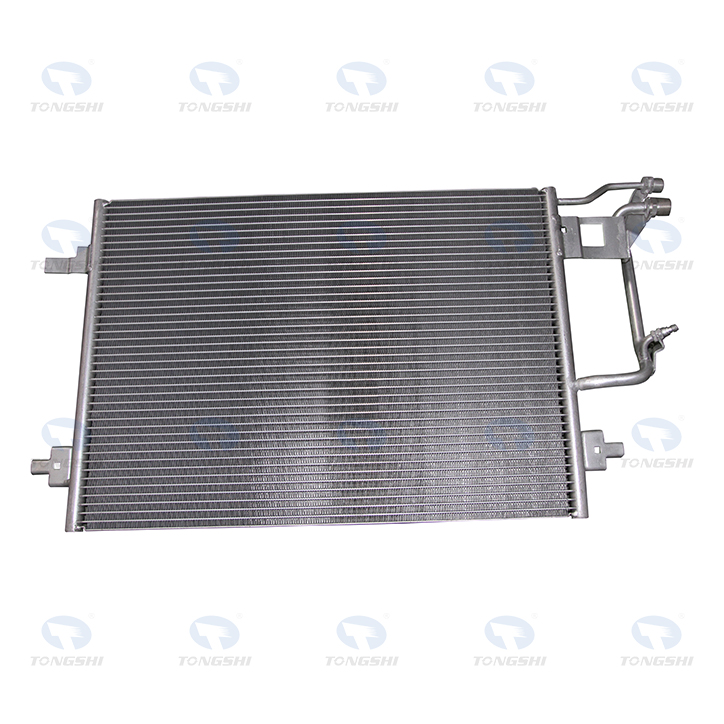
The industry has largely transitioned away from older tube-and-fin designs to parallel flow (micro-channel) architectures. Parallel flow condensers offer significantly higher heat rejection rates within a smaller footprint, making them essential for modern R134a and R1234yf refrigerant systems.
| Specification | Parallel Flow (Micro-Channel) | Serpentine / Tube & Fin |
|---|---|---|
| Thermal Efficiency | High (Optimal for modern refrigerants) | Moderate (Legacy systems) |
| Internal Pressure Drop | Low | Higher |
| Refrigerant Charge | Requires less refrigerant | Requires more refrigerant |
| Typical Application | Modern passenger vehicles, EVs | Older vehicles, heavy-duty agriculture |
When specifying a parallel flow condenser, you must define the fin pitch (measured in fins per inch or FPI), the tube wall thickness, and the depth of the core. Thinner tube walls improve heat transfer but require advanced, highly controlled brazing environments to prevent burn-through or structural weakness.
Need help identifying factories with the technical capability to produce high-efficiency micro-channel condensers? We can match your specifications with vetted manufacturers.
Talk to our teamCritical Manufacturing Processes: Brazing and Leak Detection
The defining step in condenser manufacturing is the brazing process. High-quality suppliers utilize Controlled Atmosphere Brazing (CAB), typically the Nocolok process, inside continuous nitrogen furnaces. This ensures uniform flux distribution and prevents oxidation, resulting in strong, leak-free joints between the micro-channel tubes, fins, and header blocks.
Because a condenser operates under continuous high pressure, post-braze leak testing is non-negotiable.
Factory Quality Control Indicators
- Helium Mass Spectrometry: Superior to water-bath testing; detects micro-leaks as small as 0.5 grams per year.
- Burst Pressure Testing: Samples should routinely withstand pressures up to 3.5 MPa (or higher depending on OEM spec).
- Salt Spray Testing: Chambers should verify corrosion resistance for a minimum of 500 to 1000 hours, depending on the protective coating applied.
- Nitrogen Charging: Finished condensers must be shipped with a positive dry nitrogen charge to prevent internal corrosion during transit.
Evaluating a factory's brazing furnace maintenance and leak-testing calibration is difficult from afar. Conducting thorough Factory Audits before placing high-volume orders is the most effective way to verify that these critical systems are actually in use, rather than just displayed for facility tours.
Sourcing Realities: MOQs, Tooling, and Lead Times
Pricing for air condensers fluctuates based on global aluminum indexes, the complexity of the integrated receiver drier (if applicable), and order volume.
If you are developing a proprietary cooling module for an EV or specialized heavy-duty equipment, you will need to invest in custom tooling for the header blocks and specific core dimensions. Engaging a partner for OEM/ODM Services can help you negotiate tooling ownership terms and ensure your proprietary designs remain protected.
For standard aftermarket replacements, many tier-one and tier-two Chinese manufacturers hold hundreds of existing molds for global vehicle platforms. The challenge is not finding the mold, but ensuring the factory hasn't downgraded the aluminum thickness to hit a lower price point. Implementing strict Quality Control & Inspection protocols prior to container loading ensures your specifications are met.
Managing a multi-SKU automotive cooling container? Let us handle the factory coordination, quality assurance, and logistics.
Get a free consultationFrequently Asked Questions
Sourcing automotive air condensers requires balancing aggressive aftermarket pricing with zero-tolerance quality requirements. By prioritizing factories with advanced CAB brazing furnaces and automated helium leak detection, you protect your brand from costly warranty claims and system failures.
Get Sourcing Help for Air Condensers
Tell us your requirements and our experts will connect you with verified manufacturers.